How to Write an Obituary: Examples, Templates & Guide

Updated: Jul 23

Last Words Matter™
An obituary cannot capture every moment of a life. But, it can preserve the moments that mattered most.

Writing an obituary for someone you love — or even preparing one for yourself — can feel overwhelming.
You may be wondering:
What should be included?
Is there a proper format to follow?
How personal should it be?
Where should it be published?
And during a time of grief or emotional reflection, finding the right words is often one of the hardest parts.
This guide will walk you step-by-step through writing an obituary, including examples, templates, formatting tips, and practical advice to help you create a meaningful tribute.
Quick Navigation:
Writing an obituary often happens during an emotionally exhausting week, when families are also making funeral arrangements, notifying loved ones, and handling important paperwork.
You do not need to capture every detail of a person’s life. Your goal is to preserve the facts that matter, the relationships they cherished, and the qualities and stories that made them unforgettable.
This guide will help you do that one step at a time. If you need help beyond obituary writing, read our article What to Do When Someone Dies: A Step-by-Step Guide.

Need help writing an obituary?
The most meaningful obituaries begin with the memories, relationships, and moments that reveal who someone truly was.
Our guided Obituary LifeReview® helps you uncover those stories and shape them into a thoughtful tribute for someone you love—or for yourself.
Powered by the Lastly.com LifeReview® Framework
An obituary is more than a public notice of someone’s passing. It’s a chance to honor a life, preserve memories, share accomplishments, and tell the story of someone deeply loved.
This step-by-step guide will walk you through:
What to include in an obituary
How to structure an obituary
Obituary templates you can use
Real obituary examples
Common mistakes to avoid
Where to publish an obituary
How to write your own obituary
If you’ve never written an obituary before, don’t worry. We’ll make the process simple, thoughtful, and manageable.
Lastly Tip:
The details people remember most are rarely dates and accomplishments. They're the stories, relationships, and moments that reveal who someone truly was.
What Is an Obituary?
An obituary is a written notice of a person’s death that shares important details about their life, family, accomplishments, and funeral or memorial arrangements.
A eulogy, on the other hand, is a speech delivered during a funeral or memorial service that focuses more personally on stories, memories, and relationships.
If you’re also preparing to speak at a service, our guide on how to write a eulogy includes examples, structure tips, and thoughtful ways to honor someone you love.
Traditionally, obituaries appeared in local newspapers. Today, obituaries are also commonly published:
On funeral home websites
Through online memorial pages
On social media
In community publications
On family websites or tribute pages
Modern obituaries have evolved beyond simple death announcements.
Today, many families choose to create deeply personal tributes that celebrate personality, values, relationships, and the unique story of a person’s life.
Who Writes the Obituary?
There is no single "right" person to write an obituary.
Most often, the responsibility falls to a spouse, child, sibling, or another close family member. In some families, several people work together—sharing memories, confirming important details, and ensuring the obituary reflects the person's life as completely as possible.
While funeral homes often assist with formatting and publication, the most meaningful obituaries are usually written by the people who knew the individual best.
If you've been asked to write an obituary, don't feel pressure to tell every story or capture every accomplishment. Your goal isn't to summarize an entire life. It's to preserve the moments, relationships, and qualities that best reflect who they were.
If writing feels overwhelming, start by talking with family members and close friends. Their stories often uncover meaningful memories, favorite sayings, traditions, and acts of kindness that might otherwise be forgotten.
Increasingly, many people are also choosing to write their own obituaries. Some want to ease the burden on their families. Others simply want the opportunity to tell their own story, reflect on the life they've lived, and leave behind words in their own voice.
Whether you're writing for someone you love—or writing your own—there is no perfect formula. The most meaningful obituaries are the ones that honestly capture the story of a life well lived.
Want to learn more? Our guide on Who Writes an Obituary? explores who typically writes an obituary, how families can work together, and what to do if you've been asked to take on this important responsibility.
Gather Information for the Obituary
If you are writing an obituary for yourself, then you only need to work from your own memory. However, if you are writing an obituary for someone else, you’ll want to gather some information first in order to outline an account of an individual’s life or to create a biographical sketch.
When a loved one close to you has passed away, it is important to collect as much personal information as necessary. This makes your job of writing the actual obituary a lot easier. You may want to start with a copy of the person’s résumé or online LinkedIn profile, if it is available. Then be sure to talk to family members, friends, and colleagues to find out more.
It may seem like a lot of work up front, but it’s always best to have more information than you’ll need than to not have enough information to create a well-rounded obituary.
Also, take the time to do a little fact checking to be sure you have the most accurate information. And verify the spelling of relatives’ names and any towns where the deceased lived. The survivors will appreciate your accuracy.
What Should an Obituary Include?
First, check with the newspaper that you want to print your obituary. Some newspapers have specific guidelines or restrictions on length. Some newspapers and funeral directors may offer an obituary template, or even a sample obituary. In addition, some newspapers charge by the word, line or column inch. You'll also want to understand the distribution area of the paper if you are unfamiliar with the area. So, you may want to be aware of these or any other factors before you get started.
A good obituary balances factual information with personal storytelling.
Most obituaries include:
Basic Information
- Full name
- Age
- City and state of residence
- Date of passing
Life Details
- Date and place of birth
- Parents’ names
- Education
- Career or military service
- Hobbies and passions
- Community involvement
- Accomplishments
Family Information
- Immediate surviving family members
- Family members who preceded them in death
Service Information
- Funeral or memorial service details
- Visitation information
- Burial or celebration of life arrangements
Memorial Information
- Charitable donation requests
- Special acknowledgments
- Personal closing message or quote
The most meaningful obituaries also answer an important question:
What made this person special?
That’s often what readers remember most.
How to Write an Obituary Step-by-Step
Step 1: Announce the Passing
Start with the essential announcement.
Include:
- Full name
- Age
- Location
- Date of death
Example:
John Michael Smith, 78, of Charlotte, North Carolina, passed away peacefully on May 3, 2026, surrounded by family.
You may also choose to include:
- Cause of death (optional)
- Circumstances of passing
- Tone (formal, warm, celebratory, spiritual, etc.)
Step 2: Share Important Life Details
Next, provide a brief overview of the person’s life.
Include meaningful highlights such as:
- Birthplace
- Education
- Marriage
- Career
- Military service
- Major achievements
- Volunteer work
- Faith or community involvement
Avoid simply listing dates chronologically. Instead, focus on what made their life meaningful.
Example:
John dedicated more than 40 years to teaching high school history and was known for his kindness, patience, and unforgettable storytelling.
Step 3: Highlight Personality and Passions
This is often the heart of the obituary.
Think about:
- What brought them joy?
- How will people remember them?
- What made them unique?
- What values defined them?
You might include:
- Favorite hobbies
- Humor
- Traditions
- Relationships
- Personality traits
- Life lessons
Example:
He never missed his grandchildren’s baseball games, loved fishing at the coast, and could strike up a conversation with absolutely anyone.
These details make an obituary feel personal and memorable.
Step 4: Include Family Members
List close surviving relatives and family members who preceded them in death.
Commonly included:
- Spouse or partner
- Children
- Grandchildren
- Siblings
- Parents
Example:
John is survived by his wife of 52 years, Mary Smith; his children, Jennifer Collins and David Smith; and five grandchildren.
Be sure to verify spellings and relationships carefully.
For naming order, surviving relatives, blended families, and “preceded in death” wording, see our guide to How to List Family Members in an Obituary.
Step 5: Add Funeral or Memorial Information
Include service details if they are public.
Examples:
- Date and time
- Location
- Visitation details
- Livestream information
- Reception information
Example:
A celebration of John’s life will be held Saturday, May 10, at 2:00 PM at First Baptist Church in Charlotte.
If services are private, you can simply state:
Services will be held privately by the family.
Step 6: Include Memorial or Donation Information
Many families include a charitable donation request instead of flowers.
Example:
In lieu of flowers, donations may be made to the Alzheimer’s Association or a local veterans charity.
You may also include:
- Scholarship funds
- Churches
- Animal rescues
- Community organizations
Step 7: End with a Meaningful Closing
Many obituaries end with:
- A favorite quote
- Scripture
- Words of gratitude
- A reflection on the person’s legacy
Example:
His kindness, generosity, and sense of humor will live on in all who knew him.
A thoughtful closing leaves a lasting emotional impression.
For additional wording and closing ideas, explore:
Considering AI for help with the first draft? Artificial intelligence can help organize details, improve structure, and overcome the blank page—but the memories and meaning still need to come from you. Our guide to AI Obituary: Everything You Need to Know explains how to use AI thoughtfully without losing your family’s voice.
The Four Stories Behind Every Meaningful Obituary
Most obituaries record the facts of a life.
The most memorable ones reveal the person behind those facts.
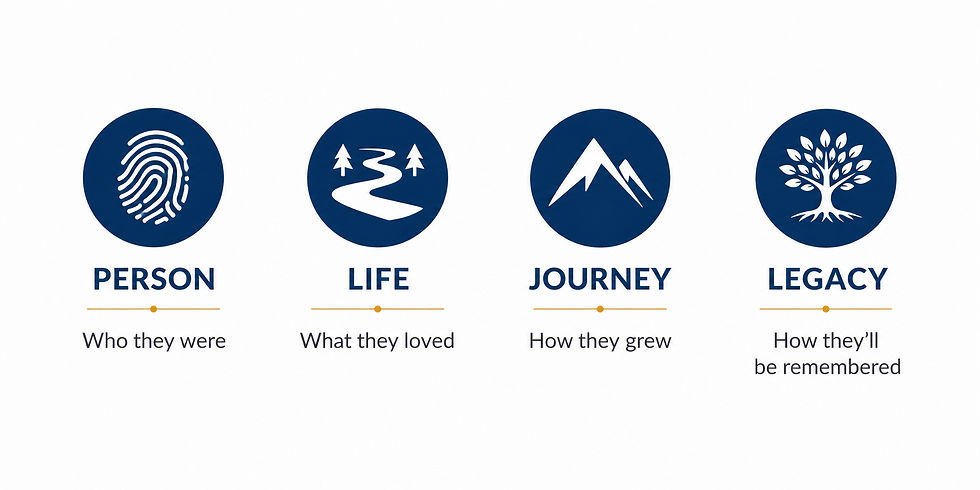
The Lastly® LifeReview® Framework helps families explore four connected dimensions of a life:
The Person — who they were and what made them unique.
Their Life — the people, passions, work, and experiences that shaped them.
Their Journey — the challenges they faced, lessons they learned, and ways they grew.
Their Legacy — the impact they had on others and how they will be remembered.
Together, these four dimensions help transform an obituary from a record of what happened into a story of why the life mattered.
Obituary Outline: A Simple Format to Follow
If you're wondering where to begin, it can be helpful to think of an obituary as a series of simple sections rather than a single piece of writing.
The outline below provides a basic structure that families can follow when writing an obituary for a loved one.
1. Announcement of Death
Begin with the person's name, age, location, and date of passing.
Example:
John Michael Smith, 78, of Charlotte, North Carolina, passed away peacefully on June 12, 2026, surrounded by his family.
2. Brief Life Summary
Share important biographical information such as birthplace, education, career, military service, or major accomplishments.
Example:
John was born in Asheville, North Carolina, and spent more than 40 years working as an engineer while raising a family he deeply loved.
3. Family Relationships
List immediate family members who survive the deceased, along with family members who preceded them in death if desired.
Example:
John is survived by his wife of 52 years, Mary Smith; children David Smith and Sarah Johnson; and six grandchildren.
4. Personal Qualities and Interests
Describe what made the person unique.
Consider including:
Character traits
Hobbies
Passions
Community involvement
Faith
Volunteer service
Example:
John was known for his kindness, love of fishing, and willingness to help anyone in need.
5. Legacy and Impact
Share a brief reflection on how the person will be remembered.
Example:
His family will remember him as a devoted husband, loving father, and trusted friend whose influence will continue for generations.
6. Funeral or Memorial Service Information
Include details about the funeral, memorial service, visitation, or celebration of life.
Example:
A memorial service will be held on June 18 at First Presbyterian Church in Charlotte.
7. Closing Tribute
End with a simple statement that honors the person's life and memory.
Example:
Though he will be deeply missed, his love, wisdom, and legacy will remain in the hearts of all who knew him.
Use this outline as a guide, but don't feel pressure to include everything. The most meaningful obituaries focus on the memories, relationships, and qualities that best reflect the person's life.

Obituary Templates
Simple Obituary Template
If you’re unsure where to begin, this obituary template can help.
[Full Name], age [XX], of [City, State], passed away on [Date].
[Name] was born on [Birth Date] in [Location] to [Parents].
They were known for [career, passions, personality traits, accomplishments].
[Name] is survived by [family members].
A [funeral/memorial/celebration of life] service will be held at [location] on [date and time].
In lieu of flowers, donations may be made to [organization].
[Closing sentiment, quote, or message].
Short Obituary Template
A short obituary is often used for newspaper notices or brief public announcements.
[Full Name], [Age], of [City], passed away on [Date].
[Name] was known for [personality trait, career, or passion].
They are survived by [family members].
[Funeral or memorial information].
Obituary Template for Mother
Writing an obituary for a mother often focuses on love, family, compassion, and the lasting impact she had on those around her.
[Full Name], beloved mother, grandmother, and friend, passed away peacefully on [Date] at the age of [Age].
She devoted her life to caring for her family and creating a home filled with love, warmth, and support.
She is survived by [children, grandchildren, family members].
A [service type] will be held at [location] on [date].
Her love, strength, and kindness will forever remain in the hearts of those who knew her.
See Meaningful Obituary Examples for Mother if you need inspiration and ideas for honoring your mother.
Obituary Template for Father
A father’s obituary often reflects guidance, strength, dedication, humor, and the values he passed down to others.
[Full Name], loving husband, father, and grandfather, passed away on [Date] at the age of [Age].
He was known for [career accomplishments, hobbies, values, or personality traits].
[Name] dedicated his life to [family, career, service, passions].
He is survived by [family members].
A [service type] will be held at [location].
His legacy of love, wisdom, and integrity will continue through the family he cherished deeply.
See Heartfelt Obituary Example for Father if you want to see simple examples of how to honor your father.
Obituary Template for a Veteran
When writing an obituary for a veteran, many families choose to honor both military service and the individual’s life beyond the uniform. A thoughtful veteran obituary often reflects duty, sacrifice, character, family, and community impact.
[Full Name], [Military Rank if desired], age [XX], of [City, State], passed away on [Date].
[Name] proudly served in the United States [Branch of Service] during [War/Conflict/Years of Service]. During military service, [he/she/they] [special accomplishments, commendations, deployments, or responsibilities].
Following military service, [Name] dedicated [his/her/their] life to [career, family, community involvement, passions].
[He/She/They] will be remembered for [personal qualities, values, or legacy].
[Name] is survived by [family members].
A [funeral/memorial/celebration of life] service will be held at [location] on [date and time].
In lieu of flowers, donations may be made to [veteran organization or charity].
Families of veterans may also wish to explore burial benefits, memorial honors, and additional resources available through the U.S. Department of Veterans Affairs.
Fill-in-the-Blank Obituary Template
Many families find it easier to begin with a simple fill-in-the-blank obituary template before adding personal stories and memories.
Use the template below as a starting point and customize it to reflect the life, personality, and legacy of your loved one.
Remember, the best obituaries go beyond facts and dates. They help readers understand the person behind the words.
Basic Fill-in-the-Blank Obituary Template
[Full Name], age [Age], of [City, State], passed away on [Date of Death].
[First Name] was born on [Birth Date] in [Birthplace] to [Parents' Names].
[He/She] is survived by [Spouse], [Children], [Grandchildren], [Siblings], and other loving family members and friends.
[First Name] spent [Number] years working as a [Occupation] and was known for
[Personal Quality or Character Trait].
Outside of work, [he/she] enjoyed [Hobbies, Interests, or Activities].
Family and friends will remember [him/her] for [Personality Traits, Values, or Contributions].
A [Funeral/Memorial Service/Celebration of Life] will be held on [Date] at [Location].
In lieu of flowers, the family requests [Memorial Donation Information or Other Wishes].
[First Name] will be deeply missed and lovingly remembered by all who knew [him/her].
How to Personalize an Obituary Template
While templates provide a helpful structure, the most meaningful obituaries include personal details that help readers understand who the person truly was.
Consider adding:
A favorite saying or quote
A meaningful family story
Community involvement
Military service
Faith and spiritual beliefs
Hobbies and passions
Life lessons they shared
The qualities people admired most
These details often become the parts of an obituary that family and friends remember most.
Lastly Tip:
An obituary cannot capture every moment of a life. It can preserve the moments that mattered most.
Start with a template. Then add the stories, relationships, and memories that made your loved one unique.
Before You Begin Writing
An obituary cannot preserve every moment of a life.
It can preserve the moments that mattered most.
Reflect on the relationships, stories, qualities, and experiences that best reveal who your loved one was. The Obituary LifeReview® helps you gather those memories and shape them into a meaningful tribute.
Powered by the Lastly.com LifeReview® Framework
How to List Family in an Obituary
One of the most common questions families have is how to properly list surviving and deceased family members in an obituary.
While there is no single correct format, most obituaries follow a traditional structure that begins with immediate family members and then expands to extended family.
Survived By
Most obituaries include:
Spouse or partner
Children and their spouses
Grandchildren
Great-grandchildren
Siblings
Other close family members
Example:
John is survived by his loving wife, Mary; children David (Jennifer) Smith and Sarah (Michael) Johnson; six grandchildren; his sister Susan Brown; and numerous nieces, nephews, and friends.
Preceded in Death By
Many families also choose to recognize loved ones who passed away before the deceased.
Example:
John was preceded in death by his parents, Robert and Helen Smith, and his brother, Michael Smith.
Large or Blended Families
For larger families, it is perfectly acceptable to simplify the listing by referring to grandchildren, great-grandchildren, nieces, nephews, and extended family collectively.
The goal is to honor important relationships without overwhelming the obituary with names.
Most importantly, focus on the people who played a meaningful role in your loved one's life.
The most meaningful obituaries begin long before the writing starts. They begin with remembering.
Simple Obituary Example
If you're looking for a straightforward format, the example below demonstrates how a simple obituary can still be meaningful and personal.
Michael Robert Carter, 74, passed away peacefully on June 12, 2026, surrounded by family.
Michael was a devoted husband, father, grandfather, and friend. He spent his life serving others through his work, his community involvement, and his unwavering commitment to family.
He enjoyed fishing, woodworking, and spending time with his grandchildren.
Michael is survived by his wife of 51 years, Susan Carter; children David Carter and Emily
Carter; four grandchildren; and countless friends whose lives he touched.
He will be remembered for his kindness, integrity, and generous spirit.
A memorial service will be held on June 18, 2026.
His family finds comfort in knowing that his legacy lives on through the people he loved and the lives he influenced.
Obituary Examples
Short Obituary Example
Sarah Williams, 84, of Atlanta, Georgia, passed away peacefully on April 18, 2026.
Sarah devoted her life to her family, church, and community. She spent more than 30 years as a nurse and was known for her compassion and unwavering kindness.
She is survived by her three children, seven grandchildren, and countless friends who loved her deeply.
A memorial service will be held Friday at 1:00 PM at Trinity Church.
Sarah’s warmth and generosity will never be forgotten.
Review our article, 25 Short Obituary Examples You Can Use Today for more ideas.
Obituary Example for a Mother
Patricia Ann Reynolds, beloved mother and grandmother, passed away peacefully on May 2, 2026, at the age of 79.
Patricia dedicated her life to her family and was known for her generous heart, beautiful cooking, and unwavering support for those she loved.
She is survived by her children, Michael and Sarah, and five grandchildren.
A celebration of life service will be held Sunday at 3:00 PM at Lakeside Chapel.
Her love and wisdom will be deeply missed and forever remembered.
Obituary Example for a Father
Robert Allen Mitchell, loving husband and father, passed away peacefully on April 30, 2026, at the age of 73.
Robert spent more than 40 years as an engineer and was admired for his integrity, generosity, and quick wit.
He loved coaching youth baseball, fishing with friends, and spending time with his grandchildren.
He is survived by his wife Linda, sons Daniel and Christopher, and four grandchildren.
A memorial service will be held Friday at 1:00 PM at Trinity Church.
His guidance and kindness will never be forgotten.
Traditional Obituary Example
William Henry Thompson, 86, of Charleston, South Carolina, passed away peacefully on May 6, 2026, surrounded by his loving family.
Born on February 14, 1940, in Savannah, Georgia, William dedicated his life to hard work, family, and service to others. After proudly serving in the United States Navy, he spent more than 35 years working as a civil engineer and helping shape communities throughout the Southeast.
William was a devoted husband, father, grandfather, and friend. He enjoyed gardening, woodworking, and spending time with family at the coast. He was known for his quiet wisdom, steady presence, and unwavering integrity
He is survived by his wife of 61 years, Margaret Thompson; children David Thompson and Laura Bennett; six grandchildren; and two great-grandchildren.
A funeral service will be held Saturday, May 11, at 11:00 AM at St. Andrew’s Church in Charleston. Burial will follow at Magnolia Memorial Gardens.
In lieu of flowers, donations may be made to the American Heart Association.
William’s kindness, strength, and love for family will be remembered always.
Veteran Obituary Example
Michael Anthony Reynolds, U.S. Army Veteran, passed away peacefully on May 14, 2026, at the age of 76.
Michael proudly served his country in the United States Army during the Vietnam War, where he earned multiple commendations for his dedication and service. He carried the values of integrity, humility, and resilience throughout every chapter of his life.
After returning home, Michael built a successful career in construction management and spent more than 30 years helping shape the community he loved. Beyond his work, he was a devoted husband, father, grandfather, and mentor to many.
Michael enjoyed fishing, woodworking, telling stories about his time in the service, and spending weekends surrounded by family. He was known for his quiet strength, generosity, and unwavering willingness to help others.
He is survived by his wife of 48 years, Susan Reynolds; children Daniel and Melissa; and five grandchildren.
A memorial service with military honors will be held Saturday, May 20, at 11:00 AM at Trinity Memorial Chapel.
In lieu of flowers, the family asks that donations be made to a local veterans support organization.
Michael’s legacy of service, kindness, and devotion to family will never be forgotten.
Celebration of Life Obituary Example
Emily Grace Harper passed away peacefully on April 28, 2026, at the age of 67, leaving behind a legacy of joy, creativity, and deep love for the people around her.
Emily approached life with warmth, humor, and curiosity. Whether she was hosting family dinners, painting in her backyard studio, or traveling with lifelong friends, she made every moment feel meaningful and memorable.
She spent more than 30 years as an elementary school teacher, where she inspired generations of students with patience, encouragement, and compassion. Outside the classroom, Emily loved music, gardening, and gathering people together whenever she had the chance.
She is survived by her husband Michael, daughters Rachel and Claire, and four beloved grandchildren.
Rather than a traditional funeral service, the family will host a Celebration of Life gathering on Sunday, May 18, at 4:00 PM at Willow Creek Gardens.
Guests are encouraged to wear bright colors and bring stories, laughter, and memories to share in honor of Emily’s beautiful spirit.
Her love and light will continue through everyone fortunate enough to have known her.
How Long Should an Obituary Be?
Most newspaper obituaries range from approximately 150 to 400 words, although requirements and costs vary by publication. Online obituaries can be longer and may include additional stories, photographs, videos, and messages from family and friends.
Many families prepare two versions:
a concise newspaper obituary,
and a more detailed online tribute.
Before writing, check the publication’s word limits, pricing, formatting rules, deadlines, and photo requirements.
For a more detailed breakdown, see How Long Should an Obituary Be?
Common Obituary Mistakes to Avoid
1. Making It Too Chronological
Don’t simply list life events in order. Focus on personality and meaning.
2. Forgetting Service Details
Double-check dates, times, and locations carefully.
3. Including Too Much Information
Not every detail needs to be included. Prioritize what mattered most.
4. Waiting Until the Last Minute
Writing under pressure can lead to mistakes and additional stress.
5. Missing Personal Touches
The best obituaries sound human—not generic.
Small details often create the strongest emotional connection.
Where to Publish an Obituary
Once you've finished writing an obituary, the next step is deciding where to share it.
Today, families have more options than ever before. Many choose to publish both a traditional newspaper obituary and a longer online version that includes additional photos, stories, and memories.
The best choice depends on who you want to reach, how quickly you want to notify others, and how you hope your loved one will be remembered.
Funeral Home Websites
For many families, the funeral home's website becomes the primary place to publish an obituary.
Most funeral homes provide a permanent online memorial page where family and friends can:
Read the obituary
Share condolences
Upload photos
Send flowers
Leave lasting memories
These pages often become the central place where family and friends gather online to celebrate a person's life and learn about funeral or memorial arrangements.
If you're still planning services, our Funeral Planning Guide can help you organize the many decisions that come after a loss.
Local Newspapers
Traditional newspapers remain one of the most common places to publish an obituary, especially when you want to notify your local community about funeral or memorial services.
Before submitting an obituary, check the newspaper's:
Word limits
Pricing
Submission deadlines
Photo requirements
Formatting guidelines
Many newspapers charge by the word or column inch, so families often prepare a shorter newspaper obituary and a longer online version.
If you're unsure how long your obituary should be, our guide on How Long Should an Obituary Be? explains typical newspaper requirements and offers recommendations for both print and online memorials.
Online Memorial Websites
Many families also choose to publish obituaries on dedicated memorial websites.
These sites often allow you to include:
Multiple photographs
Videos
Guest books
Personal stories
Funeral information
Ongoing tributes from family and friends
Unlike printed newspapers, these memorials can remain available for many years, allowing future generations to revisit stories, photographs, and memories.
Social Media
Today, many families first share a brief announcement on Facebook or other social media platforms, followed by a link to the complete obituary.
This allows friends, coworkers, classmates, and members of the community to quickly learn about the loss while directing them to one central location for service details and condolences.
If you're looking for examples of what to post, see our guide to Death Announcement Examples for wording you can adapt for social media, text messages, and family announcements.
Personal or Family Websites
Some families choose to create a dedicated tribute page where they can preserve a loved one's complete LifeStory®, photographs, videos, and family memories.
Unlike newspaper obituaries, these pages can continue growing as additional stories, photographs, and memories are shared over time.
For many families, this becomes a lasting digital legacy that can be revisited for years to come.
Before You Publish
Before submitting your obituary, take a few minutes to review every detail carefully.
Double-check:
Names and relationships
Dates
Funeral or memorial information
Locations
Spelling
Donation requests
Contact information
If possible, ask another family member to review the obituary before it's published. A second set of eyes often catches small errors during an emotional and stressful week.
What Comes Next?
Publishing an obituary is often just one of many responsibilities families face after the death of a loved one.
You may also need to:
Obtain certified Death Certificates
Notify Social Security, banks, insurance companies, employers, and other organizations
Plan a funeral or Celebration of Life
Prepare a Eulogy
Create a Funeral Program
If you're unsure where to begin, our step-by-step guide on What to Do When Someone Dies walks through the entire process—from the first hours after a loss through the weeks that follow.
If you're preparing to speak during the service, you may also find our guide on How to Write a Eulogy helpful.
How to Write Your Own Obituary
More people today are choosing to write their own obituary as a way to reflect on life, preserve their voice, and ease the burden on loved ones.
When you write your own obituary, you can create a personal summary of your life or the deceased’s life. And you can also avoid any possible mistakes that may occur when obituaries are hurriedly written at the time of death by a distraught or grieving family member. If you've ever had to write an obituary notice for someone else, then you understand what a daunting task it can be. And when that task is given with short notice, it's all-the-more difficult.
What style suits you best? Do you want it to be humorous? More serious? Should it be a listing of your proudest accomplishments? Maybe you can talk about what life meant to you, while highlighting what made your life well-lived. Some people mainly want to leave words of wisdom to their survivors. The bottom line is that if you are writing your final words proactively, it's YOUR OBITUARY and you can write it anyway you would like.
Write your obituary several different ways and review it with your family and your closest friends. You'll undoubtedly receive suggestions and feedback from those who know you best. You'll be surprised at how candid people will be, how accepting they are with what you are doing, and how insightful their advice may be for including things that might be extremely important to you.
Whatever you write, be sure to leave your own personal touch. Choose a flattering, high-resolution photo of yourself or the deceased to be published, either in print or online.
Double space between lines for easy reading, and avoid using a fancy font or colored ink. ‘Keep it Simple,’ is the best policy when writing an obituary.
And if you feel overwhelmed by the job, then most definitely ask for help. Don’t wait until the last minute. You are enduring your own grief at the same time, and your job could certainly be made easier with a helping hand.
Writing your own obituary may feel unusual at first, but many people find it deeply meaningful.
It can help you:
- reflect on your life,
- preserve your voice,
- communicate values,
- reduce stress for loved ones,
- and share the legacy you hope to leave behind.
When writing your own obituary, consider:
- What mattered most to you?
- What relationships shaped your life?
- What lessons did you learn?
- How do you hope people remember you?
Many people discover that writing their own obituary becomes less about death—and more about understanding the life they’ve lived.
Self-Written Obituary Template
If you are reading this, then my journey has come to an end.
I was fortunate to spend my life surrounded by [family, friends, passions, accomplishments].
I hope to be remembered for [values, lessons, personality traits].
I am deeply grateful for [important relationships, experiences, blessings].
Above all else, I hope the people I loved know how much they meant to me.
Self-Written Obituary Example
More people today are choosing to write their own obituaries as a way to reflect on life, preserve their voice, and reduce stress for loved ones.
If you’re reading this, then my final adventure has arrived.
I was fortunate to live a life filled with family, friendship, laughter, and purpose. I loved deeply, made mistakes, learned often, and tried never to take life too seriously.
Above all else, I hope I’m remembered as someone who showed kindness freely and loved well.
Self-written obituaries often feel especially personal and authentic.
Frequently Asked Questions About Writing an Obituary
How do you write a simple obituary?
A simple obituary includes the person’s full name, age, date of passing, key life details, surviving family members, and funeral or memorial information. The most meaningful obituaries also include personal details that reflect the individual’s personality, values, and relationships.
What should an obituary include?
Most obituaries include:
• Full name and age
• Date of passing
• Birthplace and life history
• Career and accomplishments
• Family members
• Funeral or memorial details
• Donation or memorial information
• A personal message or reflection
How long should an obituary be?
Most newspaper obituaries range from 150–400 words, depending on publication requirements. Online obituaries can be longer and often include additional stories, photos, videos, and tributes.
Can you write your own obituary?
Yes. More people today are choosing to write their own obituary as a way to reflect on life, preserve their voice, and reduce stress for loved ones. A self-written obituary can also ensure your story is told in your own words.
Who usually writes an obituary?
Obituaries are commonly written by spouses, children, close relatives, friends, or funeral directors. In some cases, individuals choose to write their own obituary in advance.
What is the difference between an obituary and a eulogy?
An obituary is a written public notice that summarizes a person’s life and passing. A eulogy is a speech delivered during a funeral or memorial service that focuses more personally on stories, memories, and relationships.
Do you have to include the cause of death in an obituary?
No. Including the cause of death is completely optional. Many families choose to keep this information private, while others share it to honor a loved one’s journey or raise awareness about an illness.
Where can you publish an obituary?
Obituaries can be published in newspapers, funeral home websites, online memorial sites, social media, and personal tribute pages. Many families choose to publish both a printed and online version.
How much does it cost to publish an obituary?
The cost of publishing an obituary varies depending on the newspaper, length, location, and whether a photo is included. Some newspaper obituaries cost under $100, while others can cost several hundred dollars.
Can an obituary be personal or humorous?
Absolutely. Modern obituaries are often more personal and reflective than traditional death notices. Many families include humor, stories, hobbies, or unique memories that capture the spirit and personality of their loved one.
Final Thoughts
Writing an obituary is never easy. But it can also be one of the most meaningful ways to honor a life and preserve memories for future generations.
The most memorable obituaries are not necessarily the longest or most formal. They are the ones that genuinely capture the spirit, personality, and story of a person who mattered deeply to others.
For many families, writing the obituary is only one part of honoring a loved one’s life. If you are also preparing to speak at a funeral or memorial service, you may find it helpful to read our step-by-step guide on how to write a eulogy.
Grief affects people differently, and taking time to reflect, write, and share memories can often be part of the healing process for families and loved ones.
Organizations such as Mayo Clinic also offer helpful grief and bereavement resources for those coping with loss.
Whether you are writing for someone you love—or writing your own story—take your time, ask for help when needed, and focus on what truly mattered most.
Continue Your Journey
If you're looking for... | Read next |
A simple format to get started | |
Short examples you can adapt | |
Meaningful wording and phrases | |
Obituary poems, quotes, and verses | |
Christian obituary wording and examples |
Obituary Examples by Relationship
Family member of friend | Read next |
Father | |
Mother | |
Husband | |
Wife | |
Grandfather | |
Grandmother | |
Brother | |
Sister | |
Friend |
Writing Help
If you need help in... | Read next |
Listing surviving family correctly | |
Writing your own obituary | |
Learning how AI can help | |
Using ChatGPT conversationally | |
Comparing AI writing tools | |
Understanding obituary generators |
At Lastly.com, Last Words Matter™
The final words written about a person's life often become part of how they are remembered.
Lastly® helps families discover, organize, and tell the story of a life well lived through guided storytelling designed for obituaries, eulogies, and lasting tributes.
Because every life has a story worth telling.
Every story deserves to be remembered.
And every meaningful obituary begins with understanding the person behind the words.


Comments