AI Obituary: What It Is, How It Works, and What AI Can’t Do


Last Words Matter™
Artificial intelligence can write an obituary in seconds.
But can it write the story of a life it never knew?
As artificial intelligence becomes part of everyday life, more families are discovering that AI can help organize information, overcome writer's block, and create a thoughtful first draft during one of life's most difficult moments.
For someone staring at a blank page while grieving, that can feel like an incredible relief.
But it's also raised an important question.
Can AI really write a meaningful obituary?

The answer is yes—with an important understanding.
Artificial intelligence can help organize facts, improve clarity, and shape your memories into a well-written obituary.
What it cannot do is remember the person you're honoring.
It doesn't know the traditions your family shared.
It doesn't remember the stories everyone still laughs about.
It never experienced the kindness, humor, faith, resilience, or love that made someone unforgettable.
Those memories belong to you.
AI can help write the words. Your memories bring them to life.
In this guide, we'll explain what an AI obituary is, how AI obituary tools work, where they can genuinely help, where they fall short, and how to use artificial intelligence in a way that keeps your loved one's story at the heart of every word.

Before AI Writes...
Someone has to Remember.
Powered by the Lastly® LifeReview® Framework
What Is an AI Obituary?
An AI obituary is an obituary created with the assistance of artificial intelligence. Rather than writing every sentence from scratch, families use AI tools to organize information, improve wording, develop an outline, or generate a complete first draft based on the details they provide.
Artificial intelligence doesn't replace the obituary writer.
It assists them.
Depending on the tool you choose, AI may help you:
Organize biographical information
Improve sentence flow
Rewrite awkward passages
Suggest different writing styles
Create shorter or longer versions
Overcome writer's block
Transform scattered notes into a complete obituary
Some families use AI only to polish an obituary they've already written.
Others rely on AI to create a first draft before revising it together.
Both approaches are becoming increasingly common.
It's also helpful to understand the difference between an AI-generated obituary and an AI-assisted obituary.
An AI-generated obituary is typically created automatically after entering basic information into a form or prompt.
An AI-assisted obituary is more collaborative. Family members provide meaningful memories, review every detail, personalize the language, and make the final decisions about what the obituary should say.
That distinction matters.
The best obituaries aren't created because artificial intelligence writes beautiful sentences.
They're created because people provide meaningful stories.
AI simply helps organize them.
How Does an AI Obituary Work?
Although different AI obituary tools use different technology, most follow a remarkably similar process.
The quality of the final obituary depends far less on the software you choose than on the memories and details you provide.
1. You Gather the Information
Everything begins with you.
Before AI can help write an obituary, someone must collect the information that tells the story of a life.
This often includes:
Full name
Birth and death dates
Education
Career
Military service
Hobbies and interests
Accomplishments
Personality traits
Favorite memories
The more thoughtful and personal the information, the more meaningful the obituary becomes.
2. AI Organizes the Information
Once you've entered your information, artificial intelligence identifies common obituary patterns and organizes your details into a logical structure.
Instead of a disconnected list of facts, it creates a story with a beginning, middle, and conclusion.
It may also improve transitions, vary sentence structure, and suggest clearer wording.
3. AI Creates a First Draft
Within seconds, the AI produces a complete draft.
Depending on the platform, you may be able to choose:
Formal or conversational tone
Short or detailed obituary
Newspaper or online format
Different writing styles
Multiple draft options
Remember, this is only a starting point.
Not a finished obituary.
4. You Review, Personalize, and Approve
This is the most important step in the entire process.
Read every sentence carefully.
Correct any factual errors.
Replace generic descriptions with meaningful stories.
Add details that only your family knows.
Remove anything that doesn't sound like the person you're remembering.
The goal isn't to let AI tell your loved one's story.
The goal is to help you tell it more clearly.

Why Families Are Turning to AI
Writing an obituary has never been easy.
It's not because people don't know how to write.
It's because they're trying to summarize an entire lifetime while navigating one of the most emotional weeks of their lives.
In just a few days, families are often making funeral arrangements, notifying relatives, meeting with a funeral home, coordinating travel, handling paperwork, and supporting one another through grief. Somewhere in the middle of all of that, they're asked to write something that feels worthy of the person they've lost.
For many people, the hardest part isn't finding the words.
It's knowing where to begin.
That's one of the reasons AI obituary tools have become increasingly popular.
Rather than replacing the writer, they help remove the intimidation of a blank page. A thoughtful first draft can provide direction, organize scattered memories, and give families something they can shape together.
When used well, AI doesn't replace reflection.
It creates more space for it.
Instead of spending hours worrying about sentence structure, families can spend that time remembering stories, sharing memories, and talking about the person they're honoring.
That's where the most meaningful obituaries begin.
Not with artificial intelligence.
But with people remembering someone they love.
What Can AI Help With?
Artificial intelligence can be a valuable writing assistant, especially during a time when emotions make it difficult to know where to begin.
While AI cannot replace your memories or your voice, it can simplify many of the practical aspects of writing an obituary and help you move from a blank page to a thoughtful first draft.
Here are some of the ways AI obituary tools can help.
Overcome Writer's Block
One of the biggest challenges families face is simply getting started.
Many people know exactly what they want to say but struggle to write the first sentence.
Others worry that whatever they write won't adequately honor someone they loved.
AI removes the intimidation of the blank page by generating an initial draft that you can review, edit, and personalize.
Instead of asking, "How do I start?"
You can begin by asking, "How can I make this sound more like them?"
Organize Information Into a Clear Structure
Families often gather dozens of notes, dates, stories, and memories from multiple relatives.
AI can organize that information into a logical obituary structure, helping ensure important details aren't overlooked while creating a smoother reading experience.
Rather than spending time deciding where every paragraph belongs, you can focus on what matters most—the memories themselves.
Improve Clarity and Grammar
Writing during grief is emotionally exhausting.
Simple spelling mistakes, awkward sentences, or repetitive wording are common and completely understandable.
AI can improve grammar, tighten sentences, and make the obituary easier to read without changing the meaning behind your words.
A careful review is still essential, but AI can save valuable editing time.
Adapt the Length for Different Uses
Many families need more than one version of an obituary.
For example, you may need:
• A shorter newspaper obituary with word limits
• A longer obituary for a funeral home website
• A version for social media
• A memorial program or celebration of life handout
Many AI tools can quickly adapt the same information into multiple formats while preserving the core story.
Suggest Different Writing Styles
Every family has a different vision for how they want to remember someone.
Some prefer a traditional obituary.
Others want a warm, conversational tribute.
Some emphasize accomplishments, while others focus on relationships and legacy.
AI can generate different versions that allow you to compare styles before choosing the one that feels most authentic.
Save Time When It Matters Most
The days following a death often involve dozens of urgent responsibilities.
Meeting with the funeral home.
Contacting family.
Planning services.
Managing paperwork.
Notifying friends.
Making travel arrangements.
Writing an obituary becomes just one more responsibility during an already overwhelming time.
AI can reduce the amount of time spent drafting, giving families more opportunity to focus on supporting one another.
The goal isn't to rush the process.
It's to remove unnecessary stress while preserving the opportunity to tell someone's story well.
When used thoughtfully, AI becomes less about replacing the writer and more about helping families spend less time struggling with words—and more time reflecting on the life those words are meant to honor.
What AI Cannot Do
As helpful as artificial intelligence has become, it's equally important to understand its limitations.
AI can organize words.
It cannot understand the life behind them.
Every meaningful obituary contains moments that only family and friends can provide—stories, relationships, traditions, and memories that no algorithm can invent.
Understanding these limitations helps ensure AI remains a tool rather than the author of someone's legacy.
AI Never Knew the Person You Loved
Artificial intelligence has never met the person you're writing about.
It doesn't know the way they laughed.
The advice they always gave.
The traditions they started.
The sacrifices they made for their family.
The quiet acts of kindness that defined their character.
Those details are what transform an obituary from a summary of facts into the story of a life well lived.
Without them, even the most polished writing can feel generic.
AI Cannot Verify Facts
Artificial intelligence only works with the information you provide.
If names are misspelled, dates are incorrect, or family relationships are entered inaccurately, AI has no way of knowing.
Before publishing an obituary, carefully verify:
• Names and spellings
• Birth and death dates
• Family relationships
• Military service
• Career history
• Funeral or memorial service information
Even small factual errors can become permanent once an obituary is published online.
AI Cannot Replace Your Voice
Many AI-generated drafts sound polished.
Some even sound beautiful.
But beautiful writing isn't always personal writing.
The phrases AI chooses may not sound like your family.
They may emphasize accomplishments when you wanted to emphasize relationships.
They may describe someone as "beloved" or "cherished" without capturing what actually made them unique.
The most meaningful obituary is one that sounds like it could only have been written about that person.
That's something only the people who knew them can create.
AI Doesn't Understand Grief
Artificial intelligence can recognize patterns in language.
It cannot experience grief.
It doesn't understand the weight of saying goodbye.
It doesn't know why one memory brings laughter while another brings tears.
Because of that, AI often misses the emotional nuance that makes an obituary truly memorable.
That's why your review matters.
The emotions behind the words should always come from the people who loved them.
Artificial intelligence can recognize the structure of an obituary. Only the people who loved someone can recognize the meaning of their life.
Are AI Obituaries Accurate?
AI obituary tools can produce well-written drafts, but they are only as accurate as the information they receive.
Artificial intelligence does not independently verify names, dates, locations, or family relationships. If incorrect information is entered, AI will often present it confidently as though it were factual.
For that reason, every AI-generated obituary should be reviewed carefully before it is shared or published.
Take time to verify every important detail, including:
• Names and spellings
• Dates of birth and death
• Surviving and predeceased family members
• Funeral or memorial service information
• Military, educational, and career history
Accuracy matters because an obituary often becomes a permanent family record. A few extra minutes spent reviewing the draft can prevent mistakes that may otherwise live online for years.
Will AI Obituaries Sound Generic?
They can—but they don't have to.
When AI receives only basic facts, it usually produces an obituary that sounds similar to thousands of others.
For example, if you simply provide a name, dates, occupation, and list of family members, the result may be well organized but emotionally flat.
The difference comes from the memories you provide.
Sharing stories about how someone lived, what they valued, how they made others feel, or the moments that defined their life gives AI meaningful material to work with.
The more personal the information, the more personal the obituary becomes.
That's why the best AI-assisted obituaries don't begin with artificial intelligence.
They begin with thoughtful conversations, meaningful memories, and the people who knew the individual best.
AI simply helps transform those memories into clear, compassionate writing.
Is It Appropriate to Use AI to Write an Obituary?
For many families, this is the biggest question of all.
It isn't about technology.
It's about respect.
Some people worry that using artificial intelligence somehow diminishes the importance of the person they're remembering. Others wonder whether an AI-assisted obituary feels impersonal or insincere.
Those are valid concerns.
The answer depends less on whether you use AI and more on how you use it.
If AI is asked to invent a life story using only a few basic facts, the result will likely feel generic and disconnected.
But when AI helps organize genuine memories, refine your writing, and overcome writer's block, it becomes something very different.
It becomes a writing assistant.
The love, memories, and meaning still come entirely from you.
Think of it this way.
Most people wouldn't hesitate to use spelling or grammar tools when writing an important letter. AI can serve a similar purpose—helping you communicate more clearly without replacing your thoughts or emotions.
The obituary is still your family's story.
AI simply helps you tell it.
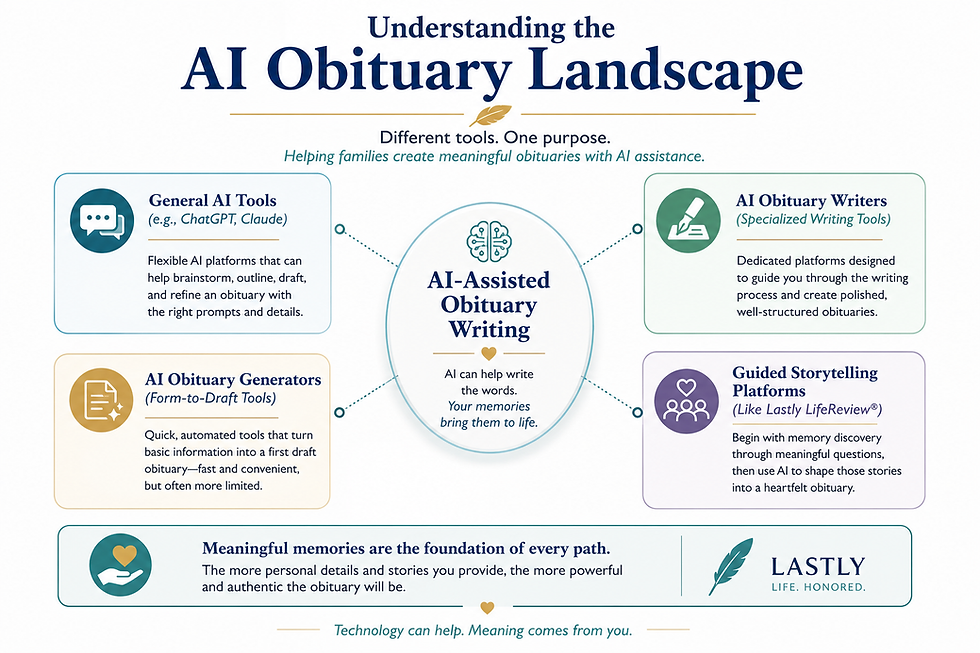
AI Obituary Writers vs. AI Obituary Generators vs. ChatGPT
As you begin researching AI obituary tools, you'll quickly discover that not all of them work the same way.
Understanding the differences can help you choose the approach that's right for your family.
AI Obituary Generators
AI obituary generators typically ask you to complete a short form with basic information, such as a person's name, dates, family members, and funeral details.
The tool then produces a complete obituary almost instantly.
These tools are fast and convenient, but they often rely on standardized formats and may leave little room for personalization.
They're best suited for creating a basic first draft that you'll continue editing.
AI Obituary Writers
AI obituary writers are generally more flexible.
Instead of relying on a simple template, they allow you to provide stories, personality traits, accomplishments, and meaningful memories.
Many also let you revise sections, change the tone, expand certain parts, or generate multiple versions.
Because they encourage greater collaboration, they often produce more personal and engaging results.
General AI Tools Like ChatGPT
General-purpose AI assistants such as ChatGPT can also help write an obituary.
Rather than completing a form, you provide prompts describing the person's life, and the
AI generates a customized draft based on your instructions.
This approach offers tremendous flexibility but also requires more guidance from the user. The quality of the obituary depends heavily on the information and prompts you provide.
For many families, ChatGPT works best as a collaborative writing assistant rather than a one-click obituary generator.
Guided Storytelling Platforms
A newer approach combines guided storytelling with artificial intelligence.
Instead of asking you to begin with a blank prompt, these platforms guide you through thoughtful questions designed to uncover the stories, relationships, values, and defining moments that made someone unique.
Once those memories have been collected, AI helps organize and refine them into a polished obituary.
This approach shifts the focus away from generating text and toward discovering the story behind the life.
Every approach has its strengths.
The most important question isn't which technology you choose.
It's whether the process helps you tell a story that feels authentic to the person you're honoring.
How to Use AI to Write a Better Obituary
Artificial intelligence works best when it's treated as a collaborator rather than a replacement.
These simple practices can help you create an obituary that feels personal, accurate, and worthy of the life it remembers.
Start With Memories, Not Prompts
Before opening any AI tool, spend time gathering stories, photographs, dates, and memories from family and friends.
The richer your memories, the richer the obituary will become.
Include Personal Details
Don't stop with names and dates.
Share the qualities people admired.
Describe favorite traditions.
Mention the hobbies that brought joy.
Include the small moments that reveal someone's character.
These are the details that transform an obituary from informative to unforgettable.
Review Every Draft Carefully
Never publish an AI-generated obituary without reading it closely.
Verify every fact.
Correct any inaccuracies.
Replace generic language with personal stories.
Read the obituary aloud to ensure it sounds natural and reflects your loved one's personality.
Ask Family Members for Feedback
Invite siblings, children, grandchildren, or close friends to read the draft before publication.
They may remember stories you've forgotten or notice details that should be corrected.
Writing an obituary is often a shared act of remembrance, and involving others can make the final tribute even stronger.
Let AI Save Time—Not Replace Thought
AI can help you organize ideas, improve sentence flow, and overcome writer's block.
But the heart of the obituary should always come from the people who knew the person best.
The technology may shape the words.
Only your memories can give them meaning.
Should You Use AI to Write an Obituary?
Artificial intelligence isn't the right choice for every family.
Some people find comfort writing every word themselves.
Others appreciate having a writing assistant to help organize their thoughts during an emotionally overwhelming week.
Neither approach is right or wrong.
The best choice is the one that allows your family to tell the story with honesty, accuracy, and love.
AI may be a good fit if you:
✔ feel overwhelmed by a blank page
✔ want help organizing your thoughts
✔ need multiple obituary versions
✔ struggle with writing
✔ want assistance editing and improving your draft
You may prefer writing without AI if you:
✔ already know exactly what you want to say
✔ enjoy writing
✔ have plenty of time
✔ prefer every sentence to come directly from family members
Many families actually choose a combination of both.
They begin by gathering memories together, write portions themselves, use AI to organize or polish the writing, and then review every sentence before publication.
The technology matters far less than the process.
The goal has never been to let artificial intelligence tell someone's story.
The goal is to help families tell it well.
Common Mistakes When Using AI to Write an Obituary
Artificial intelligence can save time and reduce the stress of writing, but it isn't a substitute for thoughtful reflection.
Avoiding a few common mistakes can help ensure the obituary feels personal, accurate, and worthy of the life it celebrates.
Relying on AI to Tell the Entire Story
The biggest mistake families make is expecting AI to create meaning from very little information.
If you provide only a person's name, dates, occupation, and a list of surviving family members, the obituary will likely feel generic.
Instead, begin with stories.
Share the moments that made people smile.
Describe what they loved, what they believed, and how they made others feel.
The more meaningful the memories, the more meaningful the obituary.
Accepting the First Draft
An AI-generated obituary should never be considered the finished version.
Think of it as a starting point.
Read through every paragraph carefully.
Expand sections that feel too brief.
Replace generic phrases with specific memories.
Adjust the tone until it sounds like your family—not like a computer.
The final draft should feel unmistakably personal.
Forgetting to Verify the Facts
Artificial intelligence cannot tell whether the information you entered is accurate.
Before publishing an obituary, double-check every important detail, including:
• Names and spellings
• Dates
• Family relationships
• Military service
• Education and career history
• Funeral or memorial service information
An obituary often becomes a permanent historical record, making accuracy just as important as thoughtful writing.
Trying to Sound Perfect
Many families worry about finding the "right" words.
As a result, they sometimes leave AI-generated language untouched because it sounds polished.
But perfection isn't the goal.
Authenticity is.
A simple sentence that sounds like your loved one is often more meaningful than a beautifully written paragraph filled with generic language.
Don't be afraid to write naturally.
Your voice matters.
Skipping Family Review
Even if one person writes the obituary, it helps to invite others to read it before publication.
Family members often remember important stories, catch factual errors, or suggest details that make the obituary even more meaningful.
Writing an obituary is rarely the work of one person alone.
It is often one family's final opportunity to tell a life story together.
The best obituaries aren't remembered because they were perfectly written. They're remembered because they were deeply personal.
The Lastly Difference
Most AI obituary tools begin by asking for information.
At Lastly, we begin by asking about the person.
Before any writing happens, the Lastly LifeReview® guides families through thoughtful conversations that uncover the stories, relationships, values, and defining moments behind a life well lived.
Instead of simply collecting facts, the LifeReview helps families remember the moments that truly matter.
Only then does AI help organize those memories into a clear, compassionate obituary.
It sounds like a small difference. In practice, it changes everything.
Rather than asking AI to invent a meaningful obituary, we give it something meaningful to work with.
Because the best obituaries don't begin with artificial intelligence.
They begin with people remembering someone they love.

Ready to Tell Their Story?
Let's begin with the memories.
Powered by the Lastly® LifeReview® Framework
Frequently Asked Questions About AI Obituaries
What is an AI obituary?
An AI obituary is an obituary created with the assistance of artificial intelligence. AI can help organize information, improve writing, and generate a first draft based on the memories and details you provide. The final obituary should always be reviewed and personalized by family or friends.
Can AI write a good obituary?
Yes—when it's given meaningful information.
AI can produce a well-written draft, but the quality depends on the stories, memories, and personal details you provide. The best AI-assisted obituaries combine thoughtful human input with AI's ability to organize and refine the writing.
Is it okay to use AI to write an obituary?
Many families find AI helpful for overcoming writer's block and organizing their thoughts during a difficult time.
Using AI is appropriate when it serves as a writing assistant rather than a replacement for personal reflection. The memories, emotions, and final decisions should always come from the people who knew the individual best.
Are AI-generated obituaries accurate?
They can be, but only if the information you provide is accurate.
AI does not independently verify names, dates, relationships, or funeral details, so every obituary should be carefully reviewed before publication.
What's the difference between an AI obituary generator and ChatGPT?
AI obituary generators usually create an obituary from a short form with basic information.
ChatGPT is a more flexible writing assistant that responds to prompts and can help rewrite, expand, personalize, or revise an obituary based on detailed instructions and memories.
Can AI make an obituary sound more personal?
Yes—but only if you provide personal information.
AI cannot invent meaningful memories or understand someone's personality. The more stories, traditions, and details you share, the more authentic the final obituary will feel.
Is AI replacing obituary writers?
No.
AI is changing how obituaries are written, but it isn't replacing the people who tell the stories.
The most meaningful obituaries still depend on the memories, relationships, and perspectives of family and friends. AI simply helps organize those stories into clear, compassionate writing.
Continue Your Journey
Learn More About AI Obituary Writing
AI Written Obituary – Learn how to use AI as a writing assistant while keeping your loved one's story authentic.
Best AI Obituary Writers – Compare the leading AI obituary writing tools and discover which approach is right for your family.
AI Obituary Generators – Understand how obituary generators work, their limitations, and when they're most useful.
AI Obituary Prompts – Ready-to-use prompts that help AI create more detailed, personal, and meaningful obituary drafts.
Traditional Obituary Resources
How to Write an Obituary – Our complete step-by-step guide to writing a meaningful obituary.
Free Obituary Templates – Printable obituary templates for families who prefer to write without AI.
Short Obituary Examples – Real-world examples for newspapers, memorial websites, and social media.
Who Writes an Obituary? – Learn who typically writes an obituary and how families can work together during the process.
Continue Your Storytelling Journey
How to Write a Eulogy – Turn memories into a heartfelt speech that celebrates a life well lived.
Guided Memory Workbook™ – Discover thoughtful questions that help uncover the stories, relationships, and moments worth remembering before you begin writing.
What to Do When Someone Dies – A step-by-step checklist for navigating the practical tasks that follow a loss.
Final Thoughts
Artificial intelligence is changing the way many people approach writing.
Obituaries are no exception.
Used thoughtfully, AI can reduce writer's block, organize ideas, improve clarity, and help families complete an important task during one of life's most difficult seasons.
But technology alone cannot tell the story of a life.
Only the people who shared that life can do that.
The most meaningful obituaries are never defined by the software that helped write them.
They are defined by the memories they preserve, the relationships they celebrate, and the love behind every word.
AI can help shape those words.
Your family gives them meaning.
At Lastly.com, Last Words Matter™
Every life deserves more than a list of dates.
At Lastly, we believe the final words we write about someone have the power to shape how they are remembered for generations to come.
Whether you write every sentence yourself or use AI as a trusted writing assistant, the goal remains the same: to preserve the story behind a life well lived.
And that story always begins with the people who remember it best.


Comments