How to List Family in an Obituary: Examples and Proper Order

Updated: Aug 12

Last Words Matter™
For many families, one of the most challenging parts of writing an obituary isn't finding the right words.
It's deciding what information to include.
Questions quickly arise.
Who should be listed?
In what order?
Should stepchildren be included?
What about former spouses?
Do I list grandchildren individually?
How do I acknowledge family members who passed away before them?
These questions are common because family is often one of the most important parts of a person's story.
An obituary is more than a public announcement of a death. It's a reflection of a life.
And the people we include help tell that story.
While there is no single "correct" way to list family members, there are common conventions that can help create a clear, respectful, and meaningful tribute.
In this guide, you'll learn how to list surviving family members, how to acknowledge loved ones who preceded the deceased in death, and examples you can adapt for your own obituary.
Because every family is unique.
And every meaningful obituary begins with understanding the people who mattered most.

Why Family Matters in an Obituary
Family information serves an important purpose in an obituary.
It helps readers understand the relationships that shaped a person's life.
While accomplishments, careers, hobbies, and community involvement are all important, family often provides the deepest insight into who someone was.
For many people, their greatest source of pride was not what they achieved, but the people they loved.
An obituary allows families to recognize those relationships and preserve them as part of the person's story.
It also creates a historical record for future generations.
Years from now, children, grandchildren, and relatives may look back at an obituary to better understand their family history and connections.
For that reason, taking time to thoughtfully list family members can make an obituary more meaningful and complete.

Need Help Finding the Right Words?
The final words we speak and write about someone have the power to shape how they are remembered.
We help families discover, preserve, and tell the story of a life well lived.
Powered by the LifeReview® Framework
How to List Family in an Obituary
Most obituaries include two family sections:
Surviving Family Members
These are the relatives who are living at the time of death.
Commonly included family members are:
Spouse or partner
Children
Sons-in-law and daughters-in-law
Grandchildren
Great-grandchildren
Parents
Siblings
Nieces and nephews
Most obituaries begin with immediate family and then move outward to extended family.
Family Members Who Preceded Them in Death
This section acknowledges close relatives who passed away before the deceased.
Common examples include:
Spouse
Parents
Children
Siblings
A simple phrase such as:
"He was preceded in death by his wife, Mary Johnson, and his parents, Robert and Eleanor Johnson."
...is often all that is needed.
Including both surviving family members and those who preceded the deceased helps create a more complete picture of the person's life and relationships.
Proper Order of Family Members in an Obituary
While there is no universal rule, most obituaries follow a traditional order when listing family members.
Typical Order for Surviving Family Members
Spouse or partner
Children
Sons-in-law and daughters-in-law
Grandchildren
Great-grandchildren
Parents
Siblings
Extended family members
For example:
"She is survived by her husband of 52 years, John Smith; her children, David Smith (Lisa) and Sarah Johnson (Michael); five grandchildren; two great grandchildren; and her sister, Carol Williams."
This approach helps readers easily understand the person's closest family relationships.
Typical Order for Family Members Who Preceded Them in Death
When listing relatives who passed away earlier, immediate family members are usually mentioned first.
For example:
"He was preceded in death by his wife, Mary Thompson; his son, Robert Thompson; and his parents, William and Eleanor Thompson."
The goal is clarity, not perfection.
Choose a format that feels natural and respectful to your family.
Obituary Family Listing Examples
Example 1: Married with Children and Grandchildren
"She is survived by her husband, John Anderson; her children, Michael Anderson (Lisa) and Jennifer Carter (David); six grandchildren; and two great-grandchildren."
Example 2: Widowed Parent
"He is survived by his daughters, Susan Martin (James) and Karen Ellis (Robert); four grandchildren; and numerous nieces and nephews."
Example 3: Large Extended Family
"She is survived by her children, grandchildren, great-grandchildren, sisters, brothers, nieces, nephews, cousins, and many dear friends."
Example 4: Family Members Who Preceded Them in Death
"He was preceded in death by his wife, Mary; his parents, Robert and Eleanor Johnson; and his brother, Thomas Johnson."
Example 5: Simple Family Listing
"She is survived by her loving family, including three children, seven grandchildren, and four great-grandchildren."
Remember that not every obituary needs to list every family member individually.
The level of detail often depends on family preferences, obituary length requirements, and publication guidelines.
How to List Blended Families, Stepchildren, and Partners
Modern families come in many forms.
An obituary should reflect the relationships that were meaningful to the person being remembered.
Stepchildren and Stepparents
Stepchildren are commonly listed alongside children when they played an important role in the person's life.
For example:
"She is survived by her children, Michael Johnson and Sarah Johnson, and her stepchildren, David Miller and Jennifer Miller."
Long-Term Partners
If the deceased had a long-term partner, it is entirely appropriate to include them.
For example:
"He is survived by his beloved partner of 18 years, Susan Walker."
Former Spouses
There is no obligation to include former spouses. However, some families choose to do so when the relationship remained important or when doing so helps acknowledge shared children and family connections.
Chosen Family
Some families choose to recognize close friends, caregivers, or others who were considered family.
An obituary is ultimately about honoring relationships that mattered.
The most meaningful approach is often the one that best reflects the person's life.
Common Mistakes to Avoid
Accidentally Omitting Close Family Members
Before publishing an obituary, carefully review the family section with other relatives to ensure no important relationships have been overlooked.
Inconsistent Naming
Try to use a consistent format throughout the obituary.
For example, either list spouses in parentheses throughout or use the same style for all family members.
Including Too Much Detail
While family relationships are important, an obituary should remain readable.
In some cases, summarizing grandchildren, great-grandchildren, or extended family may be preferable to listing every individual name.
Focusing Only on Names
Family sections provide important information, but remember that an obituary is ultimately a story about a life.
The most meaningful obituaries balance facts with memories, relationships, character, and legacy.
Family names help tell the story.
But they are not the entire story.
Before You Start Writing
Many people spend time worrying about how to properly list family members in an obituary.
And while accuracy is important, it's worth remembering that names alone don't tell the whole story.
Behind every name is a relationship.
A shared memory.
A family tradition.
A lesson learned.
A life touched.
The family section helps readers understand who mattered most to the person being remembered.
But the most meaningful obituaries go one step further.
They help readers understand why those relationships mattered.
Because an obituary is more than a list of survivors.
It's the story of a life connected to others.
Family Is Part of the Story
Listing family members is one of the most important parts of an obituary. It helps readers understand the relationships that shaped a person's life and ensures loved ones are properly recognized.
But family names alone rarely tell the whole story.
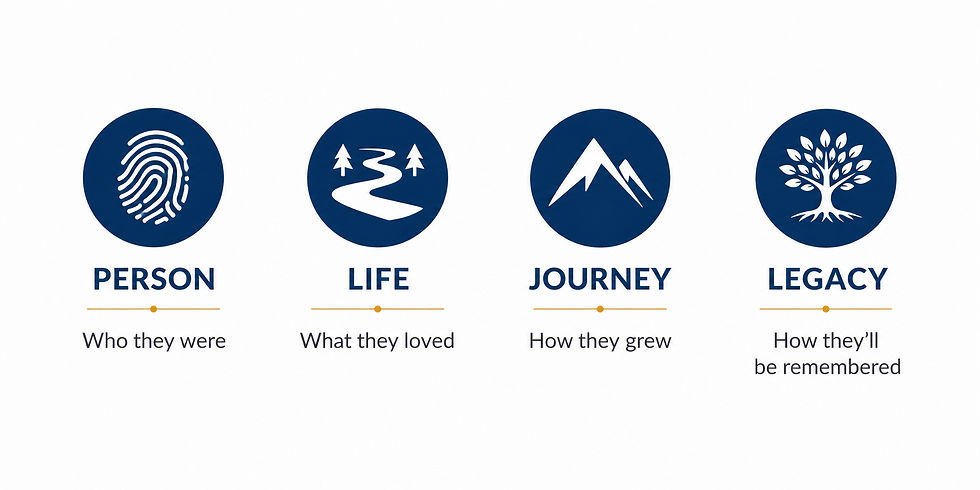
The most meaningful obituaries help readers understand not only who survived a person, but who they were as an individual, what mattered most to them, how they grew throughout their life, and the legacy they leave behind.
At Lastly, we call these four dimensions the LifeStory Framework™:
The Person — who they were.
Their Life — what they loved.
Their Journey — how they grew.
Their Legacy — how they will be remembered.
As you write an obituary, think of the family section as one chapter in a much larger stor —a story that celebrates a life well lived and the people who shared it.
Questions to Help You Remember Their Story
Before finalizing your obituary, take a few moments to reflect on the people and relationships that shaped your loved one's life.
About Family
Who were the most important people in their life?
What family traditions did they create?
How did they show love and support to others?
What role did family play in their identity?
About Relationships
What friendships lasted a lifetime?
Who could always count on them?
What relationships brought them the greatest joy?
How did they make others feel?
About Legacy
What values did they pass on to their children and grandchildren?
What lessons will family members carry forward?
What stories are told most often about them?
What will future generations remember?
The answers to these questions often become the foundation of the most meaningful obituaries.
Looking for additional inspiration? The Guided Memory Workbook™ includes thoughtful prompts designed to help families uncover stories, traditions, life lessons, and meaningful memories that can be used when writing an obituary, preparing a eulogy, or preserving a family legacy.

Need Help Finding the Right Words?
The Obituary LifeReview® helps families uncover meaningful stories, organize memories, and create a thoughtful obituary that reflects a life well lived.
Powered by the Lastly.com LifeReview® Framework
Related Resources
If you're writing an obituary and looking for additional guidance, these resources can help you organize important information, uncover meaningful stories, and create a tribute that honors a life well lived.
How to Write an Obituary — Learn how to write a meaningful obituary from start to finish, including what information to include, how to structure the tribute, and ways to make it more personal.
Obituary Template — A simple framework, fill-in-the-blank template, and obituary examples to help you get started with confidence.
Obituary Wording Examples — Explore helpful phrases, obituary wording ideas, and tribute language that can help you find the right words during a difficult time.
Frequently Asked Questions
Who should be listed first in an obituary?
Traditionally, a spouse or partner is listed first, followed by children, grandchildren,
parents, siblings, and extended family members. However, there is no strict rule.
The most important consideration is accurately reflecting the relationships that were meaningful to the deceased.
Should grandchildren be listed individually in an obituary?
It depends on family preference and obituary length. Some families choose to list every grandchild by name, while others simply state the total number of grandchildren and great-grandchildren.
How do you list family members who have already passed away?
Family members who died before the deceased are typically included in a separate
sentence, often using a phrase such as, "He was preceded in death by..." or "She was preceded in death by..."
Should stepchildren be included in an obituary?
Yes. Many families choose to include stepchildren, stepparents, and blended family
relationships when they played an important role in the person's life. An obituary should reflect the relationships that mattered most.
What if the family situation is complicated?
There is no perfect format for every family. Focus on accuracy, respect, and honoring important relationships. When in doubt, discuss the wording with close family members before publication.
Final Thoughts
Listing family members in an obituary may seem like a small detail.
But those names represent the relationships that helped shape a person's life.
The spouse who shared life's journey.
The children and grandchildren who brought joy and purpose.
The family members, friends, and loved ones who became part of their story.
While there are common guidelines for listing family members, the most important goal is creating a tribute that feels accurate, respectful, and meaningful.
Because behind every name is a relationship.
And behind every relationship is a story worth remembering.
At Lastly.com, Last Words Matter™
The final words written about a person's life often become part of how they are remembered.
Lastly® helps families discover and tell the story of a life well lived through guided storytelling designed for obituaries, eulogies, and lasting tributes.
Because every life has a story worth telling.
Every story deserves to be remembered.
And every meaningful obituary begins with understanding the person behind the words.
Because the most meaningful tributes don't begin with writing.
They begin with remembering.



Comments