What to Say in an Obituary: Meaningful Wording & Tribute Ideas

Updated: Jun 23

Last Words Matter™
The final words written about a person's life often become part of how they are remembered.
They are shared with family and friends.
Published in newspapers and online memorials.
Read during funeral services.
And revisited by future generations seeking to understand the people who came before them.

One of the greatest fears people have when writing an obituary is surprisingly simple:
"What if I don't say the right things?"
The pressure can feel overwhelming.
After all, how do you summarize an entire life in a few short paragraphs?
How do you capture someone's personality, character, relationships, accomplishments,
values, and memories without leaving out something important?
How do you find words worthy of someone you loved?
The truth is that most families are not worried about spelling mistakes or grammar.
They're worried about meaning.
They want to honor the person.
They want family and friends to recognize them in the words.
They want readers to understand why this life mattered.
And perhaps most of all, they want to be able to look back years later and feel confident they told the story well.
The good news is that meaningful obituaries are not built on perfect wording.
They are built on meaningful memories.
The goal is not to say everything.
The goal is to say what matters most.
This guide will help you discover what to say in an obituary, provide meaningful tribute wording examples, and show how storytelling can help transform an obituary from a list of facts into a lasting memory.
If you're still learning the fundamentals of obituary writing, our guide on How to Write an Obituary walks through the structure, information, and essential elements every obituary should include.
Why Most People Get Stuck
When families sit down to write an obituary, they often begin with facts.
The person's name.
Their birth date.
Their death date.
Their education.
Their career.
Their surviving family members.
These details are important.
But after the facts are written down, many people stare at a blank screen wondering what comes next.
Because facts are easy.
Meaning is harder.
You know who the person was.
You know what they did.
But how do you explain what made them special?
How do you describe a mother's unconditional love?
A grandfather's wisdom?
A friend's loyalty?
A spouse's devotion?
Those qualities often feel much bigger than words.
And yet those are exactly the things people remember most.
The Secret Is Simpler Than You Think
Many people assume a great obituary requires beautiful writing.
It doesn't.
The most meaningful obituaries often use simple language.
What matters is not how eloquently you write.
What matters is what you choose to say.
Think about the conversations people have after a funeral.
They rarely discuss résumés.
They rarely discuss awards.
Instead, they tell stories.
They remember moments.
They laugh.
They cry.
They talk about how the person made them feel.
That's because stories reveal what facts cannot.
Facts tell us what someone did.
Stories help us understand who they were.
And that distinction can completely change how you approach writing an obituary.
Before You Start Writing
Many people begin an obituary by searching for the right words.
But meaningful obituaries rarely begin with wording.
They begin with memories.
The stories your family tells again and again.
The traditions that continue today.
The lessons that still guide decisions.
The moments that reveal character.
Before you focus on sentences, take a moment to reflect on the person behind the
obituary.
What made them unique?
What did they care about most?
What story best captures who they were?
Because the strongest obituary wording often comes from memories, not vocabulary.
Start With What Made Them Unique
When people think about writing an obituary, they often begin by asking:
"What did this person do?"
A better question might be:
"What made this person unique?"
Every person has a story.
Every person has qualities, habits, passions, and quirks that made them memorable.
Think about your loved one for a moment.
What immediately comes to mind?
Was it their laugh?
Their generosity?
Their faith?
Their work ethic?
Their sense of humor?
Their ability to make everyone feel welcome?
Those are often the details that people remember long after specific accomplishments have faded.
In many cases, the most meaningful part of an obituary isn't what someone achieved.
It's who they were.
Questions That Help Uncover the Story
If you're struggling to find the right words, try answering a few simple questions:
What was this person known for?
What made them smile?
What did they love talking about?
What advice did they often give?
What qualities did others admire most?
What would family and friends immediately remember about them?
The answers to these questions often reveal the heart of an obituary.
Example
Instead of writing:
"Mary was a retired teacher."
Consider:
"Mary spent more than thirty years teaching elementary school students, but her greatest gift wasn't teaching reading or math. It was helping children believe in themselves."
The first version tells us what Mary did.
The second helps us understand who she was.
And that's often what people are really trying to say.
What Did They Love?
One of the easiest ways to make an obituary feel personal is to talk about what brought someone joy.
People are more than careers and accomplishments.
They are passions.
Relationships.
Interests.
Traditions.
Memories.
Think about the things that filled your loved one's life.
Perhaps they loved:
Family gatherings
Church activities
Gardening
Fishing
Golf
Cooking
Traveling
Volunteering
Music
Sports
Reading
These details help paint a picture of a real person rather than simply listing facts.
Example
Instead of:
"He enjoyed fishing."
Try:
"Some of his happiest days were spent on the water with family and friends, where fishing often became an excuse for storytelling, laughter, and creating memories together."
The goal isn't simply to mention a hobby.
The goal is to reveal what that hobby meant.
Questions to Help You Remember Their Story
Sometimes the hardest part of writing an obituary is not finding the words.
It's deciding which memories belong on the page.
These questions can help uncover the stories and moments that often become the heart of a meaningful obituary.
What is the first memory that comes to mind?
What made them smile?
What phrase or advice do you still hear in their voice?
What quality did people admire most?
What tradition exists because of them?
What story does your family tell again and again?
How did they make people feel?
What part of them lives on through others?
The answers often reveal the stories that matter most.
Looking for additional inspiration? The Guided Memory Workbook™ includes thoughtful prompts designed to help families uncover stories, relationships, life lessons, and meaningful memories that can be woven naturally into an obituary.
Character Leaves the Greatest Legacy
Years from now, people may not remember every detail of a person's career.
They may not remember every accomplishment.
But they often remember character.
The kindness that made them feel welcome.
The wisdom shared during difficult moments.
The generosity shown when no one was looking.
The patience.
The humility.
The faith.
The courage.
Character often becomes the lasting legacy of a life.
When writing an obituary, ask yourself:
"What character traits best describe this person?"
Then look for stories and examples that bring those traits to life.
Because readers rarely connect with labels.
They connect with examples.
Anyone can say someone was kind.
A story helps people see that kindness for themselves.
A Simple Way to Think About an Obituary
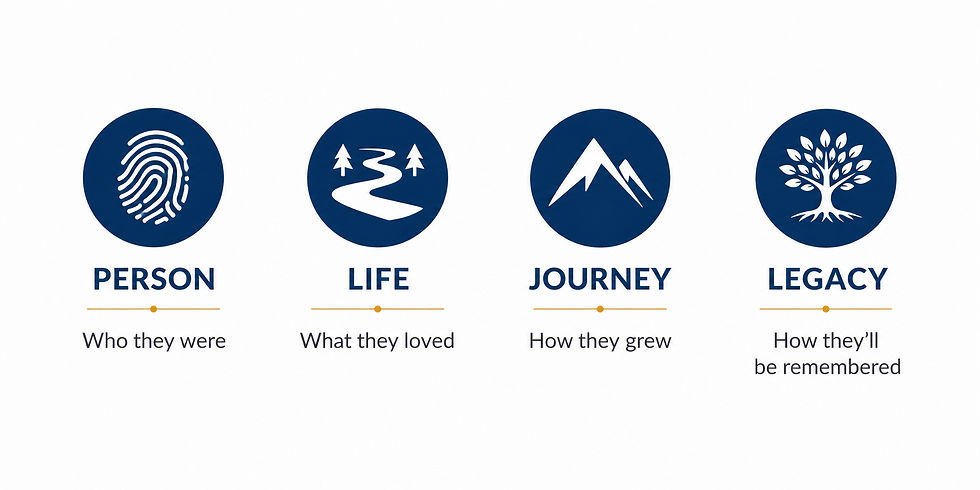
If you're still struggling with what to say, it may help to think about a person's life in four parts.
At Lastly®, we often use the LifeStory® Framework to uncover the memories,
relationships, and experiences that matter most.
Rather than focusing only on facts and accomplishments, the framework helps families reflect on the complete story of a life.

Person
Who were they?
What qualities made them unique?
What words immediately come to mind when people think of them?
Perhaps they were known for their kindness.
Their faith.
Their humor.
Their wisdom.
Their generosity.
Their determination.
The "Person" section helps readers understand the character behind the obituary.
Life
How did they spend their time?
What brought them joy?
Who and what mattered most?
This is where family, friendships, work, hobbies, faith, travel, volunteerism, and passions often come into focus.
The goal is not simply to list activities.
The goal is to reveal what made life meaningful to them.
Journey
Every meaningful life includes challenges.
Obstacles overcome.
Lessons learned.
Moments of growth.
Turning points.
These experiences often become some of the most powerful parts of an obituary
because they reveal how a person changed and grew throughout life.
The journey helps explain not only where someone went in life, but how they became the person others remember today.
Legacy
Finally, consider the impact they leave behind.
How did they influence others?
What lessons did they teach?
What traditions continue because of them?
What values live on through family and friends?
Legacy is often where the deepest meaning of an obituary is found.
Because ultimately, people are remembered less for what they owned and more for the lives they touched.
Need Help Finding the Right Words?
The Obituary LifeReview® helps families uncover meaningful stories, organize memories, and create a thoughtful obituary that reflects a life well lived.
Powered by the Lastly.com LifeReview® Framework
How Did They Make People Feel?
This may be the most important question in obituary writing.
People may forget dates.
They may forget job titles.
They may even forget specific accomplishments.
But they rarely forget how someone made them feel.
Did your loved one make people laugh?
Did they make people feel welcome?
Did they offer encouragement during difficult times?
Did they make others feel seen, valued, and understood?
When family and friends gather after a loss, these are often the stories they tell.
Not because they're the biggest stories.
But because they're the most meaningful.
Example
Instead of writing:
"John was friendly."
Try:
"John had a gift for making people feel like old friends, even if they had only just met."
Instead of:
"Sarah was generous."
Try:
"Sarah rarely missed an opportunity to help someone in need, often offering support long before anyone asked."
Specific examples create emotional connection.
And emotional connection is what transforms an obituary from information into remembrance.
The Stories People Still Tell
Think about the person you're writing about.
What stories are told again and again?
The funny story.
The family tradition.
The act of kindness.
The moment of courage.
The lesson everyone remembers.
These stories are often the heart of an obituary.
Because stories do something facts cannot.
Stories help people see the person.
Stories help people remember.
Stories help people feel.
And in many cases, a single story can reveal more about someone's life than an entire list
of accomplishments.
Looking for additional examples? Our collection of Obituary Wording Examples for Meaningful Tributes provides sample phrases and tribute language you can adapt for your loved one's story.
What to Say in an Obituary: Meaningful Wording Examples
Once you've identified the qualities, stories, and memories that best represent your loved one, the next challenge is finding the right words.
The good news is that meaningful obituary wording doesn't have to be complicated.
Simple and sincere is almost always better than elaborate and formal.
The goal is not to impress readers.
The goal is to help them remember.
For Kindness
Instead of simply saying someone was kind, try describing how their kindness appeared in everyday life.
Example:
"Her kindness touched everyone she met and often appeared in small, thoughtful ways that made others feel valued, welcome, and loved."
For Humor
Humor is often one of the most memorable parts of a person's personality.
Example:
"He never missed an opportunity to tell a story, share a joke, or find humor in life's challenges. His laughter brought joy to those around him."
For Family
Many people want their obituary to reflect the importance of family.
Example:
"Nothing brought her greater happiness than spending time with her family, creating traditions, celebrating milestones, and making memories together."
For Faith
Faith often shapes a person's character, priorities, and relationships.
Example:
"His faith guided his life and inspired others through his example of compassion, humility, and service."
For Service
Many people leave a lasting impact through helping others.
Example:
"She quietly dedicated herself to serving those around her and believed that even small acts of kindness could make a meaningful difference."
For Strength
Some lives are defined by perseverance.
Example:
"Through life's challenges, he faced adversity with courage, determination, and an unwavering commitment to those he loved."
Instead of Saying This, Say This
Sometimes a small change in wording can transform an obituary from factual to memorable.
Instead of:
"He was a hardworking man."
Try:
"He believed in showing up, working hard, and setting an example through his actions rather than his words."
Instead of:
"She loved her family."
Try:
"Her greatest joy was gathering family together, whether for holidays, celebrations, or simply an ordinary Sunday afternoon."
Instead of:
"He enjoyed fishing."
Try:
"Many of his favorite days were spent on the water, where fishing often became an excuse for storytelling, laughter, and time spent with family and friends."
Instead of:
"She was generous."
Try:
"She gave freely of her time, energy, and compassion, often helping others without seeking recognition."
Notice the difference.
The first examples provide labels.
The second examples provide images.
And people remember images far longer than labels.
The Best Obituaries Tell a Story
At its heart, an obituary is not simply an announcement.
It is a story.
The story of a life.
A collection of experiences, relationships, lessons, challenges, and memories.
The best obituaries help readers understand not only what someone did.
They help readers understand who they were.
And perhaps even more importantly, why they mattered.
That's why stories are so powerful.
Stories create connection.
Stories create emotion.
Stories help people remember.
A single story about a father's generosity, a grandmother's wisdom, or a friend's loyalty
can reveal more about a person than an entire list of accomplishments.
When you're unsure what to say in an obituary, start with the stories people still tell.
They often contain the very things that deserve to be remembered.
Start Writing Your Obituary
The Obituary LifeReview® helps families uncover meaningful stories, organize memories, and create a thoughtful obituary that reflects a life well lived.
Powered by the Lastly.com LifeReview® Framework

More Than Words on a Page
At first glance, an obituary may seem like a simple document.
A few paragraphs.
A photograph.
Some dates.
A list of family members.
But the best obituaries become something much more.
They become a record of a life.
A reminder of what mattered.
A collection of stories, values, lessons, and relationships that might otherwise be forgotten.
Years from now, children and grandchildren may read those words.
Friends may revisit them.
Future generations may discover them.
And in those moments, the obituary becomes more than an announcement.
It becomes a bridge.
A bridge between generations.
A bridge between memory and understanding.
A bridge between the facts of a life and the meaning behind it.
That is why the words matter.
Not because they need to be perfect.
But because they help preserve the story.
The stories we remember most are rarely about accomplishments alone.
They are stories of courage.
Faith.
Love.
Humor.
Perseverance.
Kindness.
Transformation.
The experiences that shaped a person and the impact they had on others.
Those are the stories worth telling.
And those are often the stories people carry with them long after the funeral is over.
Related Resources
If you're looking for additional guidance while writing an obituary, these resources can help you organize memories, uncover meaningful stories, and create a tribute that honors a life well lived.
How to Write an Obituary — Learn how to structure an obituary, organize important details, and tell the story behind a life.
Obituary Wording Examples for Meaningful Tributes — Explore additional obituary phrases, wording ideas, and examples you can adapt for your loved one.
Free Obituary Templates & Printable Examples — Discover fill-in-the-blank obituary templates, practical frameworks, and examples to help you get started.
Frequently Asked Questions
What should I say in an obituary?
A meaningful obituary typically includes important life details, family relationships, personal qualities, accomplishments, and stories that help readers understand who the person was.
How do I make an obituary more personal?
Include specific memories, family traditions, meaningful stories, and examples that reflect the person's character. Stories often create a stronger emotional connection than facts alone.
Should an obituary focus on accomplishments or personality?
The strongest obituaries include both. Accomplishments provide context, while stories and personal details help readers understand the person's character and impact.
What if I don't know where to begin?
Start with memories. Think about the stories, lessons, traditions, and relationships that best capture the person's life. The wording often becomes easier once the memories are identified.
What makes an obituary memorable?
Specific stories, meaningful memories, family traditions, and examples of character often make an obituary more memorable than a simple list of dates and accomplishments.
Final Thoughts
If you're wondering what to say in an obituary, start with this simple truth:
You do not need to tell the entire story.
You only need to tell the parts that matter most.
The qualities people admired.
The relationships that shaped a life.
The lessons learned.
The memories shared.
The impact left behind.
Focus less on creating the perfect obituary.
Focus more on capturing the essence of the person.
Because meaningful obituaries are not remembered for flawless writing.
They are remembered because they help people recognize someone they loved.
When family and friends read the words and think:
"Yes. That's exactly who they were."
You have succeeded.
At Lastly.com, Last Words Matter.™
The final words written about a person's life often become part of how they are remembered.
Lastly® helps families discover and tell the story of a life well lived through guided storytelling designed for obituaries, eulogies, and lasting tributes.
Because every life has a story worth telling.
Every story deserves to be remembered.
And every meaningful obituary begins with understanding the person behind the words.
Because the most meaningful tributes don't begin with writing.
They begin with remembering.


Comments