How Long Should an Obituary Be? A Simple Family Guide

Updated: Jun 26

Last Words Matter.™
One of the most common questions families ask when writing an obituary is:
How long should an obituary be?

Should it be a few sentences?
A few paragraphs?
Several pages?
The answer may surprise you.
There is no perfect obituary length.
Some meaningful obituaries are only 150 words.
Others span more than 1,000.
The difference isn't the number of words. It's whether those words help readers understand the person behind them.
That's welcome news for families who may already be feeling pressure to "get it right."
You don't need to include everything.
You simply need to include what matters most.
Understanding the different types of obituaries—and the purpose each one serves—can help you decide how much to write and what belongs in a meaningful tribute. If you're still getting started, reviewing a few obituary examples can be helpful.
This guide explains common obituary lengths, when each format makes sense, and how to decide what belongs in an obituary that honors a life well lived.
Before You Start Writing
Before worrying about word count, pause for a moment.
The length of an obituary is rarely what families remember.
What they remember is whether it sounded like the person they loved.
Before deciding how many words to write, ask yourself:
What made them unique?
What qualities immediately come to mind?
What stories does your family tell most often?
What do you hope future generations will learn about them?
Those answers will naturally guide the length of the obituary far better than any recommended word count ever could.
The Short Answer: Most Obituaries Are 200–500 Words
If you're looking for a quick answer, most obituaries fall somewhere between 200 and 500 words.
That length is usually enough to:
Share important life details
Mention surviving family members
Announce funeral or memorial services
Include a few personal memories
Celebrate the person's life and legacy
For many families, this range strikes a comfortable balance between providing practical information and sharing meaningful details.
However, there is no rule that says an obituary must stay within this range.
The ideal length depends on how the obituary will be used.
Why Obituary Length Varies
Where It's Published | Typical Length |
Newspaper | 150–400 words |
Funeral Home Website | 300–800 words |
Online Memorial | 500–1,500+ words |
Personal LifeStory® | No limit |
Not every obituary serves the same purpose.
Some obituaries are written primarily to announce a death and provide service information.
Others are written to preserve a life story for future generations.
Because of that, obituary length can vary significantly.
Newspaper Obituaries
Traditionally, newspapers charge by the line or word.
As a result, families often choose shorter obituaries for print publication.
Most newspaper obituaries range from 150 to 400 words.
The focus is usually on:
Basic life information
Family members
Funeral arrangements
A brief summary of the person's life
Choosing the right words can often feel harder than deciding the length. Our guide to what to say in an obituary offers examples and wording ideas for different situations.
Online Obituaries
Online memorials and funeral home websites typically have few length restrictions.
This gives families the freedom to include:
Additional stories
Personal memories
Favorite quotes
Photographs and videos
As a result, online obituaries are often much longer than newspaper versions.
Legacy Obituaries
Some families choose to create a more detailed tribute designed to preserve a loved one's story.
These obituaries may include:
Childhood memories
Career highlights
Life lessons
Family traditions
Challenges overcome
Stories that reveal personality
It's not unusual for these tributes to exceed 1,000 words.
And that's perfectly okay.
If the goal is preserving a life story, length becomes far less important than meaning.

Need Help Finding the Right Balance?
The Obituary LifeReview® helps families uncover meaningful stories, organize memories, and create a thoughtful obituary that reflects a life well lived.
Powered by the Lastly.com LifeReview® Framework
A Short Obituary Example (100–200 Words)
Short obituaries are common in newspapers where space is limited.
They focus on the most important facts while still providing a glimpse into the person's life.
Example
John William Anderson, 78, of Greensboro, North Carolina, passed away peacefully on May 15, 2026, surrounded by family.
John was born in Asheville, North Carolina, and spent more than forty years working as an electrician. He was known for his strong work ethic, generous spirit, and willingness to help anyone in need.
Above all else, John loved his family. He enjoyed fishing, attending his grandchildren's sporting events, and spending time outdoors.
He is survived by his wife of 52 years, Susan; two children, Michael and Sarah; and five grandchildren.
A memorial service will be held on May 20 at First Baptist Church.
In lieu of flowers, donations may be made to the local food bank.
When a Short Obituary Makes Sense
A shorter obituary may be ideal when:
Publishing in a newspaper
Working within a budget
Providing a simple death announcement
Sharing funeral service information
Short does not mean less meaningful.
A few well-chosen words can leave a lasting impression.
A Medium-Length Obituary Example (300–500 Words)
A medium-length obituary is often the most common format.
It provides enough space to include important life details while also allowing room for personality and storytelling.
Example
Mary Elizabeth Carter, 84, passed away peacefully on June 3, 2026, surrounded by her loving family.
Born and raised in Charlotte, North Carolina, Mary dedicated more than thirty years to teaching elementary school students. She believed every child had the ability to succeed and spent her career helping young people discover confidence in themselves.
Outside the classroom, Mary was devoted to her family, church, and community. She rarely missed a family gathering and was known for hosting holiday meals that brought generations together around a single table.
Her grandchildren often joked that she never attended a sporting event without enough snacks to feed the entire team.
Mary's faith guided her life and inspired her commitment to serving others. She volunteered for numerous community organizations and quietly helped many people who never fully knew the impact she had on their lives.
She is survived by her children, grandchildren, and great-grandchildren, who will forever cherish her wisdom, kindness, and unwavering encouragement.
A celebration of Mary's life will be held on June 10.
Though deeply missed, her legacy lives on through the countless lives she touched.
Looking for more inspiration? Explore these meaningful obituary examples for mothers to see how families honor a mother's love, influence, and legacy.
Why Medium-Length Obituaries Are Popular
This format allows families to include:
Key life facts
Family information
Personality traits
Faith and values
One or two memorable stories
A sense of legacy
For many families, this length provides the ideal balance.
A Long Obituary Example (750+ Words)
Longer obituaries are becoming increasingly common online.
Unlike traditional newspaper notices, online memorials allow families to preserve a more complete picture of a person's life.
These tributes often include:
Childhood memories
Family stories
Career accomplishments
Life lessons
Challenges overcome
Favorite traditions
Personal reflections
A longer obituary may feel less like an announcement and more like a written life story.
And for many families, that's exactly the goal.
Rather than simply documenting a death, they want to preserve a life.
The Advantage of Longer Obituaries
Longer tributes create space for:
Greater storytelling
More personality
Family memories
Future generations to learn about the person
Years from now, grandchildren may not care where someone worked.
But they may treasure the story about how Grandma taught everyone to make her famous apple pie.
The details that reveal personality often become the details people remember most.
The Real Question Isn't Length
When families ask:
"How long should an obituary be?"
they're often asking a deeper question:
"How do I make sure I don't leave out something important?"
That's a completely understandable concern.
After all, how do you summarize an entire life in a few paragraphs?
How do you capture someone's personality, relationships, accomplishments, values, and memories without feeling like you've left something out?
The truth is that no obituary can tell every story.
No obituary can include every accomplishment.
No obituary can preserve every memory.
And that's okay.
The goal of an obituary is not to say everything.
The goal is to say what matters most.
Instead of focusing on word count, consider focusing on meaning.
Ask yourself:
What made this person unique?
What did they love?
What shaped them?
How will they be remembered?
The answers to those questions often matter far more than whether the obituary is 250 words or 1,250 words.
A Simple Way to Think About an Obituary
If you're struggling to decide what belongs in an obituary, it may help to think about a person's life in four parts.
At Lastly®, we often use the LifeStory® Framework to help families uncover the stories and memories that matter most. Learn how the LifeStory® process helps families create meaningful obituaries and eulogies.
Person → Life → Journey → Legacy
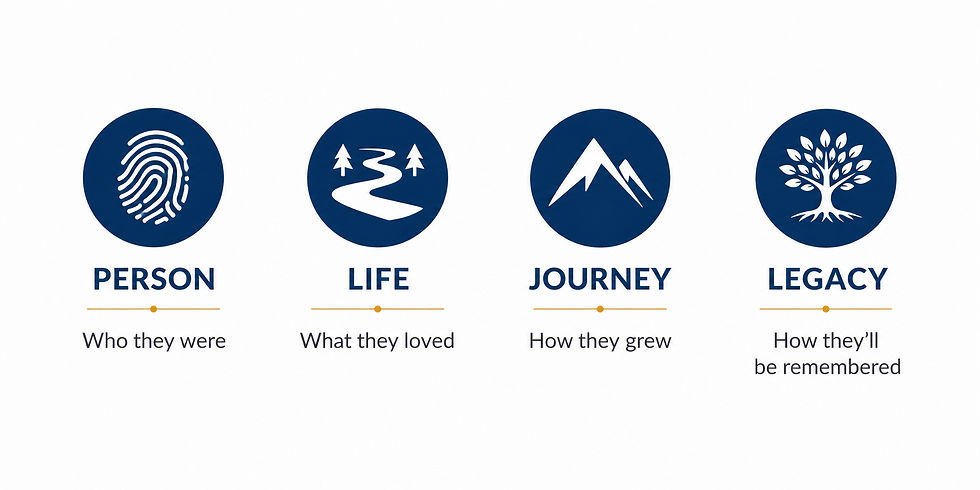
Person
Who were they?
What qualities immediately come to mind when people think of them?
Perhaps they were known for their kindness.
Their faith.
Their humor.
Their generosity.
Their determination.
These qualities often become some of the most meaningful parts of an obituary.
Life
How did they spend their time?
Who and what mattered most?
Family.
Friends.
Faith.
Work.
Hobbies.
Service.
The goal is not simply to list activities.
The goal is to reveal what made life meaningful to them.
Journey
Every meaningful life includes challenges.
Lessons learned.
Moments of growth.
Obstacles overcome.
The journey helps explain how someone became the person others remember today.
Legacy
Finally, consider the impact they leave behind.
What values continue through family and friends?
What lessons remain?
How did they influence others?
Legacy is often where the deepest meaning of an obituary is found.
Because ultimately, people are remembered less for what they owned and more for the lives they touched.
What Information Should Always Be Included?
Although obituary length varies, there are a few details that most obituaries should include.
Essential Information
Full name
Date of birth
Date of death
Place of residence
Immediate family members
Funeral or memorial service information
Personal Information
Consider including:
Career highlights
Education
Military service
Volunteer work
Faith involvement
Hobbies and interests
Personality traits
Memorable stories
These details help transform an obituary from a simple announcement into a meaningful tribute.
Common Obituary Length Mistakes
Trying to Include Everything
One of the most common mistakes is attempting to document every detail of a person's life.
The result is often a very long obituary that feels more like a résumé than a tribute.
Focus on the highlights.
Focus on the stories.
Focus on what made the person unique.
Including Only Facts
Facts are important.
But facts alone rarely help readers understand who someone truly was.
The most meaningful obituaries balance facts with personality.
Writing for Strangers
Many people write as if the obituary is intended for the public.
In reality, the people who will treasure it most are family and friends.
Write with them in mind.
Write for the people who loved the person.
Write for the grandchildren who may read it years from now.
Imagine someone discovering the obituary twenty or thirty years from now.
What would you want them to understand about this person's life?
What story would make them smile?
What lesson would help them feel connected to someone they may have never had the chance to meet?
Those are often the details worth preserving.
Start Your Obituary Today
The Obituary LifeReview® helps families uncover meaningful stories, organize memories, and create a thoughtful obituary that reflects a life well lived.
Powered by the Lastly.com LifeReview® Framework
Related Resources
If you're preparing to write an obituary, these resources can help you choose the right words and preserve the stories that matter most.
How to Write an Obituary — A complete step-by-step guide to organizing memories, writing meaningful stories, and honoring a life well lived.
Obituary Wording Examples — Explore thoughtful wording ideas, meaningful phrases, and examples you can personalize for your loved one.
Free Obituary Templates & Printable Examples — Browse fill-in-the-blank templates and practical examples to help you begin writing with confidence.
Frequently Asked Questions
What is the ideal length for an obituary?
Most obituaries range between 200 and 500 words, but there is no universally correct length. The best obituary is one that shares the stories, relationships, and qualities that mattered most.
Is a longer obituary better?
Not necessarily. A longer obituary provides more room for storytelling, but a shorter obituary can be equally meaningful when it focuses on the person's character and the memories that best represent their life.
Should newspaper and online obituaries be the same?
Many families create a shorter version for newspaper publication and a longer online version that includes additional stories, photographs, and personal reflections.
What if I can't include everything?
You don't have to. No obituary can capture every memory or accomplishment. Focus on the moments that best reflect who the person was and how they will be remembered.
Can I write more than one obituary?
Absolutely. Many families prepare a brief announcement for publication and a longer LifeStory® for future generations. Each serves a different purpose while honoring the same life.
Final Thoughts
If you're wondering how long an obituary should be, remember this:
There is no perfect length.
Some beautiful obituaries are only a few paragraphs long.
Others span several pages.
The difference isn't the number of words.
The difference is whether the obituary helps readers understand the person behind the words.
A short obituary can be meaningful.
A long obituary can be meaningful.
What matters most is that it reflects the person's life, character, relationships, and legacy.
When deciding what to include, don't focus on reaching a specific word count.
Instead, focus on answering a few simple questions:
Who were they?
What did they love?
What shaped them?
How will they be remembered?
Those answers often matter far more than any formatting rule.
The goal is not to say everything.
The goal is to say what matters most.
And when family and friends read the obituary and think,
"Yes. That's exactly who they were."
You've succeeded.
If you're struggling to identify the stories, memories, and life lessons that belong in an obituary, you're not alone.
Most families don't need more words.
They need better questions.
The Guided Memory Workbook™ helps uncover meaningful memories, relationships, traditions, and life lessons that naturally become the heart of an obituary, eulogy, or lasting family history.
At Lastly.com, Last Words Matter™
The length of an obituary is only one small part of the story.
What matters most is helping family and friends recognize the person behind the words.
Lastly® helps families discover and tell the story of a life well lived through guided
storytelling designed for obituaries, eulogies, and lasting tributes.
Because every life has a story worth telling.
Every story deserves to be remembered.
And every meaningful obituary begins with understanding the person behind the words.
Because the most meaningful tributes don't begin with writing.
They begin with remembering.


Comments