What to Do When a Spouse Dies: A Step-by-Step Guide for the Days Ahead
- Lastly.com

- Jul 8
- 10 min read

Last Words Matter™
When your spouse dies…
Life doesn’t simply change.
It feels as though the future you imagined disappears overnight.
The person who shared your home.
Your routines.
Your decisions.
Your celebrations.
Your quiet evenings.
Your dreams for the years ahead.
Is suddenly gone.
In the middle of unimaginable grief, you’re expected to make phone calls, notify family
members, plan a funeral, locate important documents, and make decisions you never
thought you’d face alone.
If everything feels overwhelming…
You’re not doing anything wrong.
You’re grieving one of life’s deepest losses.
This guide won’t ask you to figure everything out today.
Instead, we’ll walk with you through the next steps—one decision at a time—so you can care for the practical responsibilities while making space to honor the person you love.

The First Few Hours
In the first hours after your spouse dies, it’s normal to feel as though time has stopped.
You may struggle to think clearly or remember what someone just told you.
That’s okay.
You don’t need to solve everything today.
Focus only on the next few immediate steps.
If your spouse dies at home unexpectedly, call 911 so emergency personnel can respond
and guide you through what happens next.
If they were receiving hospice care, contact the hospice nurse instead, who will help you
through the next steps.
If your spouse dies in a hospital, nursing home, or other care facility, the staff will guide
you through the immediate process and answer many of your initial questions.
Once you’ve received guidance from medical professionals, consider these priorities:
Notify your closest family members and loved ones.
Contact the funeral home if arrangements haven’t already been made. If you’re unsure what happens next, our guide to planning a funeral walks through the decisions families typically make.
Ask a trusted friend or family member to stay with you if possible.
Gather important documents only if they’re easy to locate—there’s no need to search through everything today.
Take care of yourself by drinking water, eating something simple, and resting whenever you’re able.
Above all…
Don’t feel pressured to handle every responsibility yourself.
People often ask,
“What can I do to help?”
This is the time to let them.
When Every Decision Feels Like Too Much
After the death of a spouse, even the simplest decisions can feel overwhelming.
You may find yourself staring at a form without reading it.
Forgetting why you walked into a room.
Unable to answer questions that normally would have been easy.
This isn’t weakness.
It’s grief.
Researchers sometimes describe this as “grief brain”—a temporary response to
profound loss that can affect concentration, memory, and decision-making.
That’s one reason it’s so important not to expect too much of yourself in the days ahead.
When possible:
Bring a trusted family member or friend to important meetings.
Write down questions before speaking with the funeral home, attorney, or financial institutions.
Keep a notebook to track names, phone numbers, and next steps.
Don’t feel pressured to make major financial or life-changing decisions immediately unless absolutely necessary.
There will be time for those conversations.
Today, your responsibility is simply to take the next step.
Nothing more.
Lean on the People Who Want to Help
One of the hardest parts of losing a spouse is learning to accept help.
For years, the two of you likely shared life’s responsibilities together.
Now, people begin asking,
“What can I do?”
It’s okay if you don’t know the answer.
Instead of saying,
“I’m fine,”
...consider letting others help with practical tasks like:
Notifying extended family and friends.
Bringing meals or groceries.
Watching children or pets.
Driving you to appointments.
Helping organize paperwork.
Assisting with funeral arrangements. If you’re concerned about expenses, understanding typical funeral costs before making decisions can help you plan with confidence.
Sitting with you in the quiet moments when you simply don’t want to be alone.
Most people genuinely want to help.
They simply don’t know how.
Giving someone a specific task isn’t placing a burden on them.
It’s giving them a meaningful way to care for you.
During the First Week
As the initial shock begins to settle, several practical responsibilities will need your attention.
Remember…
You don’t have to complete them all in one day.
Focus on them one at a time.
During the first week, you’ll likely need to:
Meet with the funeral home to finalize funeral or memorial service plans. If your spouse didn’t leave specific wishes, you may also need to decide between burial and cremation. Our guide to Cremation vs. Burial: How to Choose What’s Right for Your Family explains the practical, financial, and personal considerations to help you make a decision that’s right for your family.
Order multiple certified copies of the death certificate.
Notify your spouse’s employer, if applicable.
Contact the Social Security Administration if it hasn’t already been notified.
Notify banks, insurance companies, and other financial institutions.
Locate important estate planning documents, including wills, trusts, and powers of attorney.
Begin gathering financial records that may be needed in the coming weeks.
If some of these tasks feel unfamiliar, don’t worry.
You don’t have to become an expert overnight.
Ask questions.
Take notes.
And don’t hesitate to lean on trusted family members or professionals for guidance.
If you’d like a printable reference, our What to Do When Someone Dies Checklist can help you stay organized as you work through each step at your own pace.
Honoring Your Spouse’s Life
Amid the practical responsibilities, you’ll also begin thinking about how to honor your spouse’s life.
For many families, that includes writing an obituary, preparing a eulogy, choosing photographs, and gathering stories to share with relatives and friends.
If those tasks feel overwhelming, remember…
You don’t have to find the perfect words today.
Begin by remembering the person you loved.
The stories.
The qualities that made them uniquely themselves.
The moments that defined your life together.
The words can come later.
If you’re looking for guidance, our step-by-step guide to writing an obituary and our guide to preparing a heartfelt eulogy can help you tell your spouse’s story with confidence and compassion.
Caring for Financial and Legal Matters
In the weeks following your spouse’s death, you’ll begin addressing financial and legal responsibilities that may feel unfamiliar or intimidating.
Take them one at a time.
Common tasks include:
Meeting with an attorney if your spouse had a will or trust.
Contacting life insurance companies.
Updating bank accounts and investment accounts.
Reviewing beneficiary designations.
Applying for any survivor benefits you may be eligible to receive.
Updating property titles, vehicle registrations, or other legal documents as needed.
Don’t hesitate to ask questions.
Most people have never handled these responsibilities before.
You aren’t expected to know all the answers.
If your spouse worked with a financial advisor, accountant, or attorney, those professionals can often help you understand the next steps.
Give Yourself Permission to Wait
After losing a spouse, people sometimes feel pressure to make major life decisions immediately.
Should you sell the house?
Move closer to family?
Retire?
Change jobs?
While every situation is unique, many grief counselors encourage waiting before making
significant, irreversible decisions whenever possible.
Grief changes how we think.
Decisions that feel urgent today may feel very different six months from now.
Unless circumstances require immediate action, give yourself permission to wait.
There is wisdom in allowing grief to settle before making decisions that shape the next chapter of your life.
Take Care of Yourself, Too
When you’ve spent years caring for someone else, it’s easy to forget that you also need care.
Grief is exhausting.
Not only emotionally…
But physically.
You may have trouble sleeping.
You may forget to eat.
Simple daily routines can suddenly feel difficult.
Try not to measure your progress by productivity.
Instead, focus on small acts of self-care.
Drink water.
Eat when you’re able.
Take a short walk.
Accept help from others.
Rest without feeling guilty.
Healing doesn’t happen because you stay busy.
It happens because you give yourself permission to grieve.
There Is No Timeline for Grief
One of the most difficult parts of losing a spouse is discovering that life around you
eventually begins moving again.
People return to work.
Phone calls become less frequent.
Visitors stop coming by.
Meanwhile…
You may still feel as though your world has stopped.
That’s normal.
Grief doesn’t follow a calendar.
There isn’t a day when you’re supposed to “move on.”
There are only small moments when carrying the loss becomes slightly more
manageable.
Some days will feel surprisingly hopeful.
Others may feel just as difficult as the first week.
Both are part of grieving.
Be patient with yourself.
Healing isn’t about leaving your spouse behind. It’s about learning how to carry their love with you as life slowly moves forward.
The Quiet That Follows
One of the hardest parts of losing a spouse isn’t something anyone prepares you for.
It’s the quiet.
The empty side of the bed.
The chair across the dinner table.
The instinct to share a story before remembering there’s no one to tell.
The silence in a home that once felt full of conversation, laughter, and everyday routines.
These moments often arrive long after the funeral is over and everyone else has
returned to their lives.
If you’ve experienced that quiet…
Please know you’re not alone.
Almost every surviving spouse discovers that grief isn’t only about missing someone.
It’s about missing the life you shared together.
There isn’t a checklist for moments like these.
There isn’t a perfect way to move through them.
There is only one day at a time.
One memory at a time.
One breath at a time.
And slowly, almost without noticing, you begin to discover that love doesn’t disappear when someone dies.
It simply becomes something you carry differently.
What to Do When a Spouse Dies: A Practical Checklist
When you’re ready, it can help to focus on one step at a time.
The checklist below summarizes many of the practical responsibilities families encounter during the hours, days, and weeks after a spouse dies. You don’t need to do everything today—but having a roadmap can make an overwhelming situation feel a little more manageable.

The LifeStory® Framework
Long after the paperwork is finished…
Long after the funeral has ended…
What remains are the stories.
The conversations.
The traditions.
The ordinary moments that, in hindsight, become extraordinary.
When someone has shared your life for decades, it can feel impossible to know where to begin writing an obituary or preparing a eulogy.
That’s because you’re not simply trying to remember facts.
You’re trying to honor an entire life.
But you can begin by remembering the whole person.
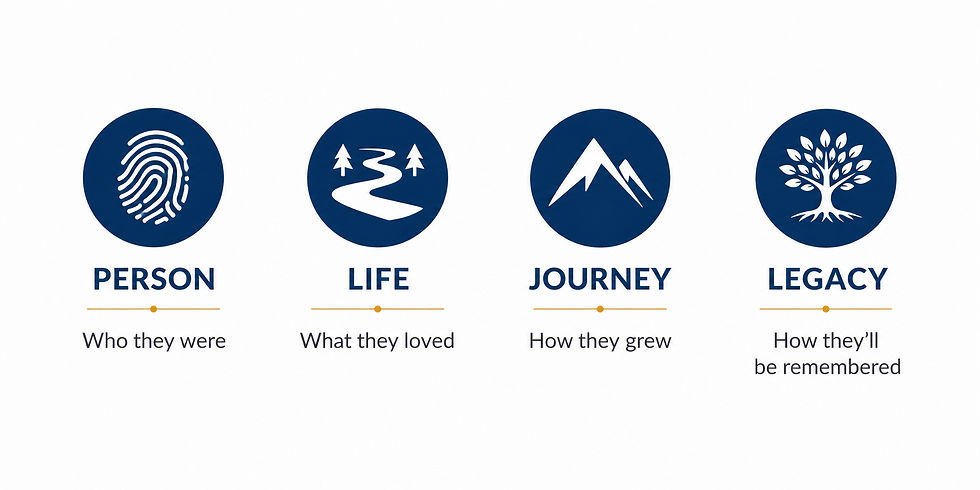
At Lastly®, we use the LifeStory® Framework to help families move beyond the final
chapter and rediscover the life that came before it.
Instead of asking,
“Where do I begin?”
We simply invite you to have four conversations.
The Person They Were
Who were they beyond the titles of husband or wife? What qualities made them
uniquely themselves?
The Life They Lived
What filled their days? What passions, traditions, friendships, and experiences defined
their life?
The Journey They Traveled
What challenges did they overcome? What moments shaped who they became? What lessons did they teach simply by the way they lived?
The Legacy They Leave
What continues because they lived? What values, memories, traditions, and love will continue shaping your family for generations?
Because while death marks the end of a life…
It doesn’t mark the end of their story.
Guided Memory Workbook™
After losing a spouse, one of the greatest fears many people experience is surprisingly simple.
“What if I forget?”
Not the important dates.
Not the milestones.
The little things.
The stories you always told.
The way they laughed.
The phrases only they used.
The traditions the two of you created together.
Those everyday memories often become the treasures we miss most.
The Guided Memory Workbook™ was created to help preserve those memories
through thoughtful conversation starters that gently uncover the stories behind a life
well lived.
Whether you’re writing an obituary today or simply hoping to preserve your spouse’s
story for your children and grandchildren, every memory you record becomes part of the
legacy they leave behind.
Because someday…
The stories you remember today may become the stories your family treasures forever.

Continue Your Journey
If you’re navigating the loss of a spouse, these resources can help you take the next step—whether you’re making practical decisions or preparing to honor the person you love.
Practical Guidance
What to Do When Someone Dies: A Step-by-Step Guide — A comprehensive checklist covering the first hours, days, and weeks after the loss of a loved one.
How to Plan a Funeral — Learn what decisions families typically make when planning a funeral or memorial service.
Cremation vs. Burial: How to Choose What’s Right for Your Family — Compare the practical, financial, and personal considerations to help you make an informed decision.
Honoring Your Spouse’s Life
How to Write an Obituary — Learn how to write an obituary that reflects your spouse’s personality, relationships, and the life you built together.
How to Prepare a Heartfelt Eulogy — Discover thoughtful guidance for sharing meaningful memories and celebrating your spouse’s life with confidence.
Frequently Asked Questions
What should I do first when my spouse dies?
Focus on the immediate responsibilities first. Notify the appropriate medical professionals, contact close family members, and reach out to a funeral home if arrangements haven’t already been made. You don’t have to solve everything in one day.
Should I make major financial decisions right away?
Unless circumstances require immediate action, many grief professionals recommend waiting before making major financial or life-changing decisions. Give yourself time to grieve before making choices that shape your future.
What documents will I need after my spouse dies?
Common documents include the death certificate, will or trust documents, life insurance policies, Social Security information, financial account records, and any funeral pre-arrangements. Don’t worry if you can’t locate everything immediately.
Is it normal to feel unable to think clearly?
Yes.
Many people experience what is sometimes called “grief brain,” making concentration, memory, and decision-making more difficult. This is a normal response to profound loss and usually improves with time.
Will life ever feel normal again?
Life may never return to exactly what it was before.
But over time, many people discover that while grief changes, love remains. Healing doesn’t mean forgetting your spouse. It means learning to carry their memory with you as you continue living.
Final Thoughts
There is no checklist that can prepare someone for losing the person they expected to
grow old with.
The responsibilities that follow are real.
The paperwork matters.
The phone calls need to be made.
But none of those things define the life you shared together.
What defines it are the ordinary moments that became extraordinary because you
experienced them side by side.
The conversations over morning coffee.
The traditions that belonged only to the two of you.
The laughter.
The challenges you overcame together.
The quiet understanding that comes only after years of sharing a life.
As you move through the difficult days ahead, be patient with yourself.
Accept help when it’s offered.
Take one step at a time.
And remember…
The love you shared didn’t end when your spouse’s life ended.
It continues in every story you tell.
Every tradition you keep.
Every lesson you pass on.
Every life they touched through yours.
Because while death changes the future you imagined…
It can never erase the life you built together.
At Lastly.com, Last Words Matter™
When a spouse dies, finding the right words can feel impossible.
That’s why Lastly® helps families discover and tell the story of a life well lived through thoughtful conversations that uncover the memories, relationships, and defining moments that deserve to be remembered.
Because every meaningful obituary…
Every heartfelt eulogy…
And every lasting LifeStory®…
Begins the same way.
With a conversation about someone you love.


Comments