What to Do After a Loved One Dies: Practical & Emotional Support for Families

Updated: Jul 2

Last Words Matter™
But so do the quiet moments when words aren't needed at all.

What to Do After a Loved One Dies
When someone you love dies, life changes immediately.
Nothing feels normal.
Simple decisions suddenly feel overwhelming.
The routines that once seemed ordinary become surprisingly difficult.
One moment you're grieving.
The next, you're making phone calls, notifying family members, meeting with funeral
directors, and trying to make important decisions while your heart is still trying to make
sense of what has happened.
It's a difficult place that many families unexpectedly find themselves.
You may be wondering...
How do I support my spouse?
My children?
An aging parent?
How do I care for everyone else while grieving myself?
The truth is that there is no perfect way to navigate the days and weeks following a loss.
There is only the next step.
And then the one after that.
In this guide, you'll find practical guidance for the responsibilities that follow a death,
along with compassionate ways to care for yourself and the people you love during one
of life's most difficult seasons.
If your loss is very recent, our guide What to Do When Someone Dies: A Step-by-Step
Checklist walks through the important tasks that often arise during the first hours and days after a death.
Before You Try to Take Care of Everyone Else...
When someone dies, many people immediately shift into caretaker mode.
You start making phone calls.
Answering questions.
Supporting family members.
Handling arrangements.
Trying to stay strong for everyone around you.
Those things matter.
But so do you.
Take a slow breath.
Drink a glass of water.
Accept help when someone offers it.
You don't have to carry every responsibility alone.
The days ahead will ask a great deal of you.
You don't have to do everything today.
You only have to take the next step.
Focus on Immediate Needs First
After a death, even the simplest tasks can feel surprisingly difficult.
Grief affects far more than our emotions.
It can affect sleep.
Concentration.
Decision-making.
Appetite.
Energy.
Even remembering simple things.
During the first few days, try not to worry about doing everything perfectly.
Instead, focus on the basics.
Help make sure family members are:
Eating regular meals
Drinking enough water
Resting when possible
Taking necessary medications
Accepting help from others
When friends, neighbors, or extended family offer to bring meals, help with childcare, run errands, or answer phone calls, consider saying yes.
Many people genuinely want to help.
They simply don't know how.
Giving someone a specific way to support your family becomes a gift to both of you.
And remember...
You don't have to accomplish everything today.
You only need to care for what today requires.

Need Help Preparing an Obituary or Eulogy?
Our LifeReview® helps families discover the stories behind a life well lived, creating a meaningful foundation for a heartfelt and memorable tribute.
Powered by the Lastly.com LifeReview® Framework
During the first hours after a death, it's common to wonder:
What am I supposed to do now?
When emotions feel overwhelming, having a simple checklist can reduce uncertainty and help you focus on one decision at a time.
You don't have to remember everything.
You only need to know the next step.
Understand That Everyone Grieves Differently
One of the most important things to remember is that grief looks different for everyone.
Some people cry openly.
Others become quiet and withdrawn.
Some want to talk constantly about the person who died.
Others need time before they can discuss the loss.
None of these reactions are wrong.
Family members often process grief differently based on their personality, relationship
with the deceased, life experiences, and coping style.
You may even notice your own emotions changing from day to day.
Sadness.
Anger.
Confusion.
Relief.
Regret.
Gratitude.
All of these feelings can be normal parts of grief.
Try to avoid comparing your grief to someone else's or expecting family members to grieve in the same way you do.
There is no timeline.
There is no formula.
There is only the process of learning how to move forward while carrying the memory of someone you love.
Support Family Members Without Trying to Fix Their Grief
When someone you love is hurting, the natural instinct is often to make things better.
But grief is not a problem that can be solved.
It's an experience that must be lived through.
One of the greatest gifts you can offer a grieving family member is simply your presence.
You don't need to have the perfect words.
You don't need to provide answers.
You don't need to make the pain disappear.
You simply need to show up.
Sometimes support looks like:
Sitting quietly together
Listening without giving advice
Bringing a meal
Helping with errands
Offering a hug
Sharing a memory
Many people worry about saying the wrong thing after a death.
In reality, most grieving people aren't looking for perfect words.
They're looking for people who care enough to be there.
What to Say to Someone Who Is Grieving
Simple expressions of compassion are often the most meaningful.
Consider saying:
"I'm so sorry."
"I'm thinking about you."
"I don't have the right words, but I'm here."
"Tell me about them."
"What can I do to help today?"
Sometimes the most powerful support comes not from speaking, but from listening.
What to Do After a Parent Dies
Losing a parent is one of life's most significant transitions.
Even when a parent has lived a long and full life, their death can leave children feeling untethered.
For many adults, the loss of a parent is also the first time they become responsible for managing major decisions on behalf of the family.
Responsibilities may include:
Funeral planning
Managing finances
Handling legal documents
Supporting surviving family members
Organizing personal belongings
Settling an estate
At the same time, you're grieving your own loss.
That combination can feel overwhelming.
If a surviving parent remains, remember that they may be experiencing a completely different type of grief.
The person who died may have been their spouse, companion, and partner for decades.
While handling practical matters, make space to check in on their emotional needs as well.
And don't forget your own.
Even when you're the one coordinating everything, you're still someone's son or daughter who has experienced a profound loss.
Make Space for the Stories
In the weeks following a death, families often gather around kitchen tables, living rooms, photo albums, and old family stories.
These moments matter.
They help us remember.
They help us reconnect.
And often, they help us heal.
You may find yourself hearing stories you've never heard before.
Stories from childhood.
Stories from friends.
Stories from coworkers.
Stories that reveal something new about a person you've known your entire life.
These conversations often become some of the most meaningful parts of the grieving process.
Don't rush through them.
Make space for them.
Ask questions.
Share memories.
Look through photographs.
Record stories if possible.
Long after funeral arrangements have been completed, these memories often become part of the legacy that remains.
Sometimes healing begins not by moving on from someone, but by remembering them together.
Remember to Care for Yourself, Too
When a loved one dies, many people naturally focus their attention on everyone else.
They help with funeral arrangements.
They support grieving family members.
They answer phone calls.
They handle paperwork.
They become the person everyone depends on.
But grief affects caregivers, organizers, and helpers too.
You cannot pour from an empty cup.
As difficult as it may feel, make time to care for yourself during this season.
That might include:
Getting adequate sleep
Taking walks
Exercising
Spending time outdoors
Talking with trusted friends
Meeting with a counselor
Participating in a faith community
Journaling your thoughts and emotions
You don't have to be strong every moment of every day.
You don't have to carry the entire burden alone.
Allow others to care for you just as you care for them.
Grief is heavy enough without trying to carry it by yourself.
Sometimes Showing Up is Enough
People often worry about saying the wrong thing after a death.
The truth is that most grieving people won't remember every word that was spoken.
But they will remember who showed up.
They'll remember the friend who brought dinner.
The neighbor who cut the grass.
The coworker who checked in weeks later.
The family member who sat quietly beside them when there was nothing to say.
Support isn't always found in grand gestures.
More often, it's found in simple acts of presence.
A text message.
A phone call.
A handwritten note.
A shared memory.
A willingness to listen.
When someone is grieving, your presence often matters more than your words.
And sometimes the greatest gift you can offer is simply reminding them that they don't
have to walk through the darkness alone.
Looking for Guidance During the First Days After a Loss?
When someone dies, families are often faced with dozens of important decisions in a very short period of time.
Our free What to Do When Someone Dies Checklist provides practical, step-by-step guidance to help you navigate the first hours, days, and weeks following a loss.
Because when emotions are overwhelming, having a simple plan can provide clarity and peace of mind.

Before the Stories Fade, Preserve Them
One of the greatest fears many families experience after a loss is forgetting.
The stories.
The traditions.
The lessons.
The little moments that made someone uniquely who they were.
In the weeks and months following a death, memories often begin surfacing naturally
through conversations, photographs, and family gatherings.
The Guided Memory Workbook™ helps families capture those stories, memories, and
reflections before they fade with time.
Because the memories we preserve today often become the stories future generations treasure tomorrow.

Related Resources
The days and weeks after losing a loved one often bring new questions. These guides can help you navigate both the practical responsibilities and the emotional journey that follows.
What to Do When Someone Dies: A Step-by-Step Checklist — Follow a practical checklist covering the important tasks that often arise during the first hours, days, and weeks after a death.
How to Plan a Funeral — Learn how to plan a meaningful funeral or memorial service that reflects your loved one's life, values, and wishes.
How to Write an Obituary — Discover how to write an obituary that shares your loved one's story while providing important service information.
How to Write a Eulogy — Learn how to prepare a heartfelt eulogy that celebrates a life well lived through meaningful stories and personal memories.
Guided Memory Workbook™ — Preserve treasured stories, family memories, and life lessons before they fade with time.
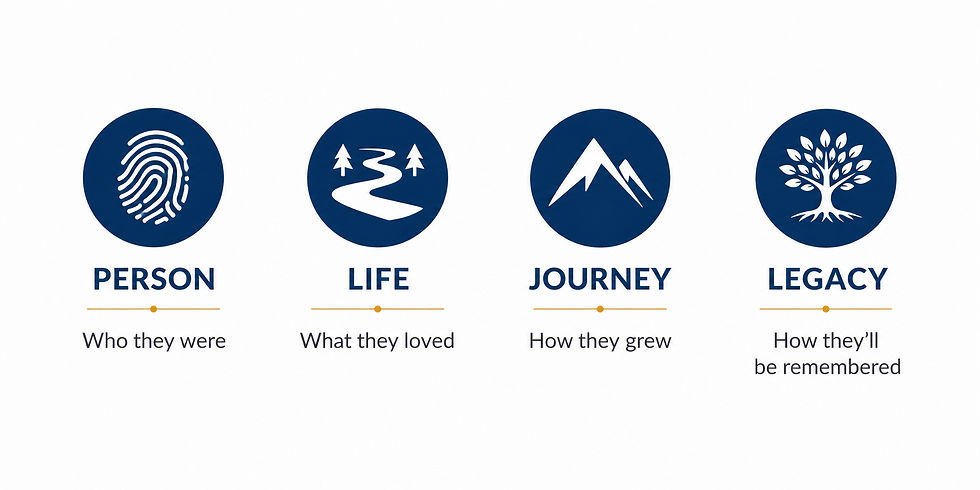
The LifeStory® Framework
Every life is made up of more than dates and milestones.
It's made up of relationships, experiences, challenges, and the countless moments that shape who a person becomes.
At Lastly®, we use the LifeStory® Framework to help families discover the memories that often become the foundation for meaningful conversations, heartfelt obituaries, inspiring eulogies, and lasting family stories.
The Person
Who were they at their core? What qualities immediately come to mind? How did they make others feel?
Their Life
What brought them joy? What passions, relationships, and traditions defined their life?
Their Journey
What challenges did they overcome? What lessons did they teach through the way they lived?
Their Legacy
What continues because they lived? What stories, values, and traditions will future generations continue to carry forward?
Whether you're planning a funeral, writing a tribute, or simply remembering someone you love, the most meaningful stories rarely begin with writing.
They begin by remembering the life behind the words.
Frequently Asked Questions
What should I do first after a loved one dies?
Start by taking care of the immediate needs. Notify the appropriate people, contact a funeral home if necessary, and lean on trusted family members or friends for support. If the death was recent, our What to Do When Someone Dies Checklist can help guide you through the first steps.
How can I support someone who is grieving?
One of the greatest gifts you can offer is simply your presence. Listen without trying to fix their grief, offer practical help, check in regularly, and allow them to grieve in their own way and on their own timeline.
What should you avoid saying to someone who is grieving?
Avoid phrases that minimize their loss, such as "Everything happens for a reason" or "They're in a better place," unless you know those words will bring comfort. Instead, simple expressions like "I'm here for you" or "I'm so sorry for your loss" are often the most meaningful.
How long does grief last?
There is no timeline for grief. Every person experiences loss differently, and emotions may continue to evolve for months or even years. Healing doesn't mean forgetting—it means learning how to carry the love and memories forward.
How can families preserve memories after someone dies?
One of the best ways is to intentionally gather stories while they're still fresh. Conversations, photographs, journals, videos, and guided reflection tools like the Guided Memory Workbook™ can help preserve the memories that future generations will treasure.
Final Thoughts
The days after losing someone you love can feel like a blur.
There are phone calls to make.
People to care for.
Decisions to make before your heart has had time to catch up.
If that's where you find yourself today...
Be gentle with yourself.
Take one step.
Then another.
Accept help when it's offered.
Share stories whenever they come.
Allow yourself to laugh without guilt.
Allow yourself to cry without apology.
Healing rarely arrives all at once.
It often comes quietly...
One conversation.
One memory.
One act of kindness.
One day at a time.
And while life will never be exactly the same...
Love has a remarkable way of continuing through the stories we tell, the traditions we
keep, and the people who carry those memories forward.
At Lastly.com, Last Words Matter™
After a loss, there are practical tasks that must be completed.
Phone calls must be made.
Documents must be signed.
Arrangements must be planned.
But beyond those responsibilities lies something equally important.
Remembering.
The stories we share around kitchen tables.
The photographs we pass from hand to hand.
The lessons we continue to carry.
The memories that remind us who someone was and why they mattered.
These moments help keep a person's story alive long after the funeral has ended.
At Lastly®, we help families discover and tell the story of a life well lived through guided
storytelling designed for obituaries, eulogies, and lasting tributes.
Because every life has a story worth telling.
Every story deserves to be remembered.
And every meaningful tribute begins with understanding the person behind it.
Because memories matter.
Stories matter.
And last words matter™.


Comments