Cremation vs. Burial: How to Choose What's Right for Your Family

Updated: Jul 7

Last Words Matter™
The decisions we make after a loss are deeply personal. The most meaningful choice is the one that best honors the life that was lived.

When someone you love dies, you're suddenly asked to make important decisions during one of the most emotional times of your life.
One of the first—and often one of the most difficult—is whether to choose burial or cremation.
Before making this decision, many families find it helpful to understand what needs to happen immediately after someone dies, especially if they're navigating these arrangements for the first time.
For some families, the decision is straightforward because their loved one made their wishes known long before they passed away.
For others, it's a conversation filled with questions about family traditions, religious beliefs, costs, environmental considerations, and what feels like the most meaningful way to honor a life.
The good news is this:
There isn't one right choice. There is the choice that's right for your family.
In this guide, we'll explain the differences between burial and cremation, compare the practical considerations, and help you make a thoughtful decision that reflects your loved one's wishes and your family's values.
Before You Decide...
Before comparing burial and cremation, it's important to remember one thing.
This decision isn't a test.
There isn't a "better" option.
Families make different choices for different reasons, and each can be a meaningful way to honor someone who has died.
As you consider your options, ask yourself a few simple questions:
Did your loved one ever express their wishes?
Are there religious or cultural traditions you want to honor?
How important is having a permanent place to visit?
What financial considerations should your family keep in mind?
How do you want future generations to remember and celebrate this person's life?
If your loved one also asked you to write their obituary or prepare a eulogy, preserving those wishes now can make those tributes even more meaningful.
Beginning with these questions often makes the decision feel less overwhelming.
Burial vs. Cremation: A Quick Comparison
Consideration | Burial | Cremation |
Traditional funeral | ✔ Common | ✔ Also possible |
Viewing beforehand | ✔ Yes | ✔ Yes (before cremation) |
Permanent gravesite | ✔ Yes | Optional |
Ashes can be kept or scattered | ✖ No | ✔ Yes |
Generally lower overall cost | ✖ Usually higher | ✔ Often lower |
Religious acceptance | Widely accepted | Depends on faith tradition |
Flexibility for memorial timing | Moderate | High |
There Isn't One Right Answer
If you're hoping this article will tell you whether burial or cremation is the "right" choice, you may be disappointed.
That's because there isn't one answer that fits every family.
Some people find comfort in having a gravesite they can visit for years to come.
Others find meaning in scattering ashes somewhere that held special memories.
Some follow religious traditions.
Others honor personal wishes that were shared long before death.
Each decision is deeply personal.
And each can be a beautiful way to celebrate a life well lived.
The goal isn't to choose what someone else would choose.
The goal is to choose what feels most consistent with the life, values, and wishes of the person you're honoring.
1. Honor Your Loved One's Wishes First
If your loved one shared their wishes before they died, that is often the best place to begin.
Some people clearly express whether they prefer burial or cremation through conversations with family, advance directives, estate planning documents, or prepaid funeral arrangements.
Honoring those wishes can bring tremendous peace to everyone involved.
If their preferences were never discussed, don't feel discouraged.
Many families find themselves making this decision together, guided by what they know about the person's values, beliefs, and personality.
Reflecting on favorite memories, traditions, and defining moments helps clarify these difficult decisions.
Ask yourself:
What would they have wanted?
Did they ever talk about funerals or memorial services?
Were family traditions important to them?
Would one option feel more consistent with the way they lived?
When you're making decisions from a place of love and respect, you're already honoring the life they lived.
2. Consider Religious and Cultural Traditions
For many families, faith and cultural traditions play an important role in choosing
between burial and cremation.
Some religions have long-standing preferences for burial, while others fully embrace
cremation or allow families to choose either option.
Cultural customs may also influence how a person's life is honored, remembered, and
celebrated.
If faith was an important part of your loved one's life, consider speaking with your clergy
member, spiritual leader, or funeral director before making a final decision.
They can often explain traditions, answer questions, and provide reassurance during a
difficult time.
For families without specific religious or cultural expectations, this decision often comes
down to personal values and what feels most meaningful.
There isn't one universally correct choice.
Only the one that best reflects the life you're honoring.
3. Understand the Financial Considerations
Cost is another factor many families need to consider, and it's perfectly appropriate to include it in your decision.
While cremation is often less expensive than a traditional burial, the overall cost depends on the type of services you choose.
For example, expenses may include:
Funeral home services
A viewing or visitation
A casket or urn
Cemetery or burial plot fees
Grave opening and closing costs
Headstone or memorial marker
Crematory fees
Celebration of life or memorial service
It's also important to remember that cremation doesn't prevent your family from holding a traditional funeral.
Likewise, choosing burial doesn't mean the service has to be elaborate.
Every family has different priorities, and meaningful remembrance is never measured by how much money is spent.
The most meaningful services reflect the person being remembered—not the size of the budget.
If you're comparing costs across different types of services, our guide to Understanding Funeral Costs explains what families can generally expect and where expenses often arise.
4. Think About How Your Family Wants to Remember
Long after the funeral is over, what often remains isn't the decision itself.
It's the memories.
For some families, visiting a gravesite becomes an important tradition. It offers a quiet place to reflect, celebrate birthdays, leave flowers, or simply feel close to someone they miss.
For others, keeping an urn at home, placing it in a columbarium, or scattering ashes in a meaningful location feels like a more personal way to honor a life.
Neither choice is more meaningful than the other.
They're simply different expressions of remembrance.
As you think about what feels right, consider questions like:
Will future generations want a place to visit?
Is there a location that held special meaning for your loved one?
Would they have preferred a traditional family cemetery or a more personal memorial?
What choice best reflects the way they lived their life?
The goal isn't simply to choose burial or cremation.It's to choose the way you'll remember someone you love.
5. Remember That Burial and Cremation Aren't Either/Or
One of the biggest misconceptions is that choosing cremation means giving up the traditions of a funeral.
In reality, families have far more flexibility than many people realize.
For example, you can:
Hold a traditional viewing before cremation.
Have a funeral service with family and friends before cremation takes place.
Schedule a memorial service days or even weeks later, allowing loved ones more time to travel.
Bury cremated remains in a cemetery.
Place an urn in a columbarium.
Scatter ashes in a meaningful location where permitted.
Divide ashes into keepsake urns or memorial jewelry for family members.
Likewise, families who choose burial can personalize the service in countless meaningful ways.
The decision between burial and cremation doesn't determine how meaningful the funeral will be.
The love shared, the stories told, and the people gathered together are what families remember most.
6. There Is No Wrong Choice
Families often worry about making the "right" decision.
That's completely understandable.
But in most cases, there isn't one perfect answer.
There is simply the choice that best reflects your loved one's wishes, your family's values,
and the way you hope to remember their life.
If you're also responsible for writing the obituary or speaking at the funeral, remember that those words often becomes just as meaningful as the decisions surrounding the service itself
If your decision is made with love...
If it reflects the person you're honoring...
If it brings peace to your family...
Then you have already made a meaningful choice.
Because honoring a life has never been about choosing the perfect arrangement.
It's about remembering a remarkable person with dignity, gratitude, and love.
Need Help Knowing What to Do Next?

The LifeStory® Framework
Whether your family chooses burial or cremation, the most important decision has nothing to do with where someone rests.
It has everything to do with how they are remembered.
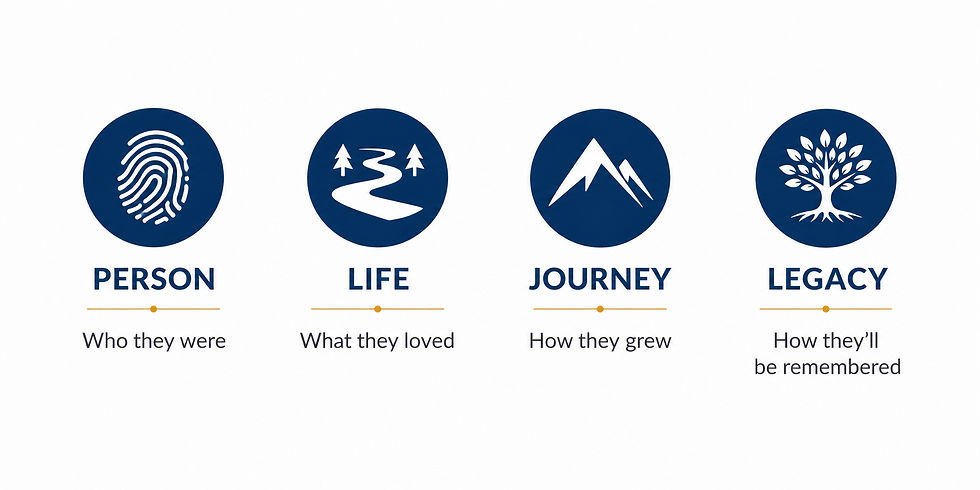
At Lastly®, we use the LifeStory® Framework to help families discover the stories that often become the foundation of meaningful obituaries, heartfelt eulogies, and lasting remembrance.
The Person
Who were they beyond the milestones? What qualities immediately come to mind? How did they make people feel?
Their Life
What brought them joy? What traditions, passions, and relationships defined the life they lived?
Their Journey
What challenges did they overcome? What lessons did they teach through the way they lived?
Their Legacy
What continues because they lived? What stories, values, and memories will future generations carry forward?
The place where someone rests is important.
But the stories they leave behind are what continue shaping the people who loved them.
Guided Memory Workbook™
The decisions families make after a loss are important.
But so are the stories that survive long after those decisions have been made.
The Guided Memory Workbook™ helps families preserve meaningful memories, treasured conversations, family traditions, and life lessons before they fade with time.
Whether you're writing an obituary, preparing a eulogy, or simply hoping to preserve a loved one's story for future generations, it offers thoughtful prompts that help uncover
what made their life so remarkable.
Because years from now...
People may not remember every detail of the funeral.
But they'll remember the stories.
Related Resources
If you're making funeral decisions after the loss of a loved one, these additional guides may help.
What to Do When Someone Dies: A Step-by-Step Guide — Learn what needs to happen first, who to contact, and how to navigate the days following a loss.
Celebration of Life Ideas — Discover thoughtful ways to honor a loved one's personality, values, and legacy through a meaningful memorial service.
Funeral Readings — Explore comforting readings, poems, prayers, and scripture that can bring hope and encouragement during a funeral or memorial service.
Frequently Asked Questions
Is cremation less expensive than burial?
In many cases, yes. However, the total cost depends on the services your family chooses, including viewings, memorial services, cemetery fees, urns, caskets, and other arrangements.
Can you still have a traditional funeral if you choose cremation?
Absolutely. Many families hold a viewing or funeral service before cremation, while others schedule a memorial service afterward.
Is burial or cremation better?
Neither option is universally better. The right choice depends on your loved one's wishes, your family's values, religious beliefs, financial considerations, and the way you hope to remember them.
Can cremated remains be buried?
Yes. Many families choose to bury an urn in a cemetery, place it in a columbarium, or scatter ashes in a meaningful location where permitted.
What if my loved one never shared their wishes?
You're not alone. Many families make this decision together based on what they know about their loved one's values, beliefs, and personality. Choosing with love and thoughtful consideration is one of the best ways to honor their memory.
Final Thoughts
Choosing between burial and cremation is one of the first major decisions families face after a loss.
It's also one of the most personal.
As you weigh your options, remember that this decision isn't about finding the perfect answer.
It's about honoring a unique life in a way that reflects the person you love.
Whether your family chooses a traditional burial, cremation, or another meaningful form of remembrance, what matters most isn't the method.
It's the love behind the decision.
The conversations shared.
The stories remembered.
The lives forever changed because this person was here.
Years from now, your family may remember the funeral.
They'll almost certainly remember the stories.
And those stories will continue shaping future generations in ways that no memorial ever could.
At Lastly.com, Last Words Matter™
The decisions we make after someone dies become part of how we honor their life.
But it's the stories we preserve that become part of how they are remembered.
That's why we believe meaningful remembrance begins long before an obituary is written or a funeral is planned.
It begins by remembering the person behind every decision.
Lastly® helps families discover and tell the story of a life well lived through guided storytelling designed for obituaries, eulogies, and lasting remembrance.
Because every meaningful decision begins with a life worth remembering.



Comments