What to Do When a Parent Dies: A Step-by-Step Guide for Families

Updated: Jul 8

Last Words Matter™
When a parent dies, life changes in an instant.
Whether you lose your mother, your father, or the person who raised you, the grief is
unlike anything you've experienced before. Along with the heartbreak often comes a
flood of responsibilities—making phone calls, notifying family, planning a funeral, and
handling countless decisions while you're still trying to process the loss.
If you're feeling overwhelmed, you're not alone.
You don't have to figure everything out today.
This guide will walk you through the practical first steps after losing a parent while also offering gentle reminders to care for yourself and your family along the way.

Losing a Parent Changes Everything
No matter your age, losing a parent changes something deep within you.
Even if you knew this day was coming, the reality of it can feel impossible to comprehend.
For many people, a parent has always been a source of wisdom, encouragement,
tradition, or unconditional love. When they're gone, it's common to feel as though the
world has shifted beneath your feet.
At the same time, life doesn't pause.
Family members look to one another for answers.
Funeral arrangements need to be made.
Important decisions can't always wait.
If that feels overwhelming, know this:
You don't have to solve everything today. You simply need to focus on the next right step.
One decision.
One conversation.
One day at a time.
Focus on Immediate Needs First
The first days after losing a parent can feel overwhelming. Here's a simple roadmap of what many families experience in the hours, days, and weeks ahead.

Fortunately, very few decisions truly need to be made right away.
Start by confirming the death with the appropriate medical professionals, notifying close
family members, and contacting a funeral home if arrangements haven't already been
made.
If your parent left written instructions, advance directives, or prepaid funeral plans,
gather those documents before making major decisions.
Everything else can happen one step at a time.
You don't need to have every answer today.
You simply need to keep moving forward with the people who love them most.
Many families also find it helpful to keep a comprehensive What to Do When Someone Dies Checklist nearby so nothing important gets overlooked.
Let Family Share the Responsibility
When a parent dies, it's common for one person to feel like they have to carry everything.
Maybe you're the oldest sibling.
Maybe you live closest.
Maybe everyone naturally looks to you to make decisions.
While it's natural to step into a leadership role, remember that you don't have to do
everything alone.
If possible, divide responsibilities among family members.
One person can contact relatives.
Another can gather important documents.
Someone else can coordinate with the funeral home or help plan the service.
Sharing responsibilities doesn't just lighten the workload.
It gives everyone an opportunity to contribute in a meaningful way during an incredibly difficult time.
Every Person Will Grieve Differently
One of the hardest parts of losing a parent is realizing that even siblings can grieve in very different ways.
One person may cry openly.
Another may become quiet.
Someone may focus on practical tasks simply because staying busy feels easier than sitting with the pain.
Try not to mistake a different expression of grief for a lack of love.
There is no single "right" way to mourn the loss of a parent.
Extend grace to one another.
The goal isn't for everyone to grieve the same way.
It's to support one another through one of life's most difficult experiences.
Grief doesn't divide families. Misunderstanding one another's grief sometimes can.
Gather Important Documents
Once the immediate notifications have been made, begin gathering the documents you’ll need in the days ahead.
These may include:
Death certificate
Will or estate planning documents
Advance healthcare directives
Life insurance policies
Financial account information
Social Security information
Military discharge papers (DD Form 214), if applicable
Funeral or cemetery pre-arrangements
Don’t worry if you can’t find everything immediately.
Many of these documents can be located over the coming days, and funeral directors, attorneys, financial institutions, and government agencies can often help guide you through the process.
Taking time to organize these documents now will make many of the next steps easier.
As you begin working through these responsibilities, you may encounter unfamiliar terms such as executor, probate, or estate administration. If your parent left a will or estate plan, remember that you don’t have to understand everything immediately. Our guides to What Is an Executor? and What Is Probate? explain these topics in simple, family-friendly language.
If your parent had life insurance, you’ll also want to understand How to File a Life Insurance Claim. Likewise, you’ll likely need several certified copies of the death certificate to notify banks, insurance companies, and government agencies. Our guide to How Many Death Certificates Do I Need? explains why families often order more copies than they expect.
If you’re beginning to make funeral arrangements, our guide to Understanding Funeral Costs can help you prepare for many of the expenses families commonly encounter after a loss.
If your parent served in the military, locating their DD Form 214 early can make it easier to arrange military funeral honors and apply for certain veterans’ benefits. Our guide to What Is a DD Form 214 and Why Is It Important After Someone Dies? explains what it is, where to find it, and why families are often asked to provide it.
Begin Planning the Funeral Together
Planning a funeral while grieving a parent is never easy.
Some decisions may already have been made through prepaid arrangements or written wishes.
Others may need to be discussed as a family.
As you begin planning, focus on what would best reflect your parent's life, values, and personality.
Whether your family chooses a traditional funeral, a celebration of life, burial, or cremation, remember that there isn't one perfect way to honor someone's life.
The most meaningful services aren't remembered because they were elaborate.
They're remembered because they reflected the person everyone came together to celebrate.
If your family hasn't yet decided between burial and cremation, understanding the differences between each option can make one of the biggest funeral decisions feel a little less overwhelming.
As you begin making funeral arrangements, you’ll likely discover that two of the most meaningful ways to honor your parent are through the obituary and the eulogy.
The obituary helps tell the story of their life and preserves it for future generations.
The eulogy gives family and friends an opportunity to celebrate who they were through memories, stories, and the lessons they shared.
If you’re not sure where to begin, our guides on How to Write an Obituary and How to Prepare a Heartfelt Eulogy will walk you through each step.
Support Yourself While You Grieve
It's easy to become so focused on caring for everyone else that you forget to care for
yourself.
After losing a parent, there will be phone calls to make, paperwork to complete,
decisions to discuss, and people depending on you.
In the middle of all of that, remember that you're grieving, too.
Give yourself permission to rest when you're exhausted.
Accept help when friends or family offer it.
Take breaks from making decisions when possible.
Most importantly, don't expect yourself to "be okay" simply because you've stayed busy.
Grief has a way of catching up with us.
Being kind to yourself isn't avoiding responsibility.
It's recognizing that you've experienced one of life's most significant losses.
Remember That Your Parent's Story Is More Than Their Final Days
In the days following a parent's death, it's easy for life to become consumed by logistics.
Death certificates.
Funeral arrangements.
Legal documents.
Financial accounts.
Those responsibilities matter.
But they are only the final chapter of a much larger story.
Long before there were decisions to make, there were birthdays celebrated together.
Family vacations.
Lessons taught around the dinner table.
Quiet moments of encouragement.
Traditions that shaped who you became.
The love they gave.
The sacrifices they made.
The laughter you'll never forget.
Those are the moments that deserve to be remembered.
As you begin honoring your parent's life, don't let the paperwork become the whole story.
Remember the life that came before it.
The final days are part of their story. They should never become the story itself.
Honor the Life They Lived
When the immediate responsibilities begin to settle, many families find themselves asking a different question.
How do we make sure they're never forgotten?
The answer isn't found in a death certificate or a funeral program.
It's found in the stories.
The memories.
The lessons they passed down.
The traditions they created.
The lives they influenced.
Those are the things that continue long after the funeral has ended.
That's why we believe every meaningful obituary, heartfelt eulogy, and lasting tribute begins by remembering the whole person—not simply the day they died.
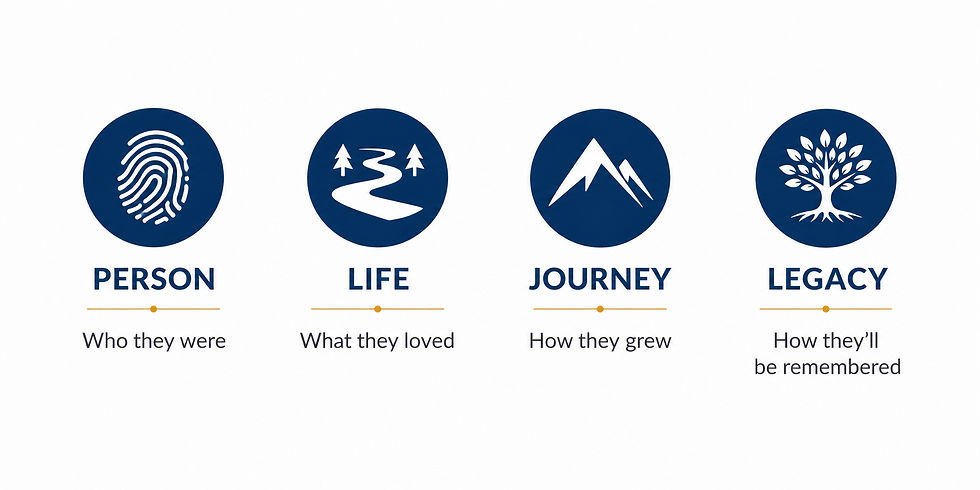
The LifeStory® Framework
Every parent leaves behind more than memories.
They leave behind a story.
At Lastly®, we use the LifeStory® Framework to help families discover the moments, relationships, and life experiences that often become the foundation of meaningful obituaries, heartfelt eulogies, and lasting family stories.
The Person
Who were they beyond the role of "Mom" or "Dad"? What qualities made them uniquely themselves?
Their Life
What passions, traditions, friendships, and experiences filled their years?
Their Journey
What challenges did they overcome? What lessons did they teach simply by the way they lived?
Their Legacy
What continues because they lived? What values, memories, and stories will your family carry forward?
Because while losing a parent changes your life...
The story they leave behind continues shaping it.
Those Stories Will Soon Become the Words You Share
In the days ahead, you may find yourself writing your parent's obituary or preparing a eulogy.
That responsibility can feel overwhelming.
Many people worry they'll forget something important or struggle to find words that truly reflect the life their parent lived.
That's why we encourage families to begin with the stories.
The moments that made you laugh.
The lessons they taught.
The traditions they created.
The people they loved.
When you begin there, writing an obituary or preparing a eulogy becomes less about finding perfect words...
...and more about telling the story only your family can tell.
If you're looking for guidance, our step-by-step resources can help.
Guided Memory Workbook™
The memories you have today will become the stories your children and grandchildren treasure tomorrow.
The Guided Memory Workbook™ was created to help families preserve those stories before they fade with time.
Through thoughtful prompts and guided reflection, it helps uncover the moments, traditions, life lessons, and memories that make every parent's story unique.
Whether you’re writing an obituary today, preparing a eulogy, or simply hoping to preserve your family’s history for future generations, every story you record becomes part of the legacy they leave behind.
Because someday...
The memories you preserve today may become the stories your family treasures forever.
Because someday...
The stories you remember may become the stories your family tells for generations.

Continue Your Journey
If you’re navigating the loss of a parent, these resources can help you take the next step—whether you’re making practical decisions or preparing to honor a life well lived.
Practical Guidance
What to Do When Someone Dies: A Step-by-Step Guide — A comprehensive checklist covering the first hours, days, and weeks after the loss of a loved one.
How to Plan a Funeral — Learn what decisions families typically make when planning a funeral or memorial service.
Understanding Funeral Costs — Explore the common expenses families encounter and learn how to make thoughtful financial decisions during funeral planning.
Cremation vs. Burial: How to Choose What’s Right for Your Family — Compare the practical, financial, and personal considerations to help your family make an informed decision.
Honoring a Life Well Lived
How to Write an Obituary — Learn how to write an obituary that reflects your parent’s personality, relationships, and the life they lived.
How to Prepare a Heartfelt Eulogy — Discover thoughtful guidance for sharing meaningful memories and celebrating your parent’s life with confidence.
Frequently Asked Questions
What should I do immediately after a parent dies?
Begin by notifying the appropriate medical professionals, close family members, and your chosen funeral home. Once the immediate needs have been addressed, you can begin gathering important documents and making funeral arrangements one step at a time.
How do I help my surviving parent?
One of the greatest gifts you can offer is simply your presence.
Listen more than you speak.
Help with everyday responsibilities when possible.
Understand that grief looks different for everyone, and your surviving parent may need both practical support and companionship in the weeks and months ahead.
What if my parent didn't leave funeral instructions?
Many families find themselves making these decisions together.
Think about your parent's values, personality, faith, and the conversations you shared throughout their life. Making decisions from a place of love and respect is one of the best ways to honor them.
How long does it take to settle a parent's affairs?
Every situation is different.
Some tasks can be completed within a few weeks, while settling an estate may take several months or longer. Focus on the most immediate responsibilities first and remember that not everything needs to be completed at once.
Is it normal to feel overwhelmed after losing a parent?
Absolutely.
Losing a parent is one of life's most significant transitions. Feeling overwhelmed, exhausted, uncertain, or emotionally drained is a natural response to grief. Give yourself permission to ask for help and take one step at a time.
Final Thoughts
Losing a parent is something we know will happen someday.
Knowing that, however, never makes the loss easier.
In the days ahead, there will be responsibilities to manage, decisions to make, and
moments when grief arrives unexpectedly.
Give yourself permission to move through them one step at a time.
Lean on the people who love you.
Accept help when it's offered.
Remember that there is no right way to grieve, and no timetable for healing.
Most importantly...
Don't let the final chapter become the only chapter you remember.
Remember the bedtime stories.
The family traditions.
The advice that still echoes in your mind.
The laughter around the dinner table.
The sacrifices they made without asking for recognition.
Those are the moments that shaped your life.
Those are the stories worth carrying forward.
Because although a parent's life eventually comes to an end...
The love they gave, the lessons they taught, and the story they leave behind continue
through the people they loved most.
At Lastly.com, Last Words Matter™
The days after losing a parent are filled with decisions.
But the years that follow are filled with memories.
That's why we believe meaningful remembrance begins by looking beyond the final days
and remembering the whole story of a person's life.
Lastly® helps families discover and tell the story of a life well lived through guided
storytelling designed for obituaries, eulogies, and lasting remembrance.
Because while we cannot change the fact that someone we love has died...
We can help ensure their story continues to live on.



Comments