How to Start a Eulogy: Meaningful Opening Examples & Tips

Updated: Jul 30

Last Words Matter™
The final words spoken about a person's life often become part of how they are remembered.
They are shared with family and friends.
Remembered for years to come.
And sometimes become part of the legacy they leave behind.

In This Guide
Standing in front of family and friends to deliver a eulogy can feel overwhelming.
For many people, writing the eulogy itself is not the hardest part.
The hardest part is knowing how to begin.
What do you say in those first few moments?
How do you find words that feel meaningful and sincere?
And how do you speak when your own heart is grieving?
If you're struggling with how to start a eulogy, you're not alone.
Many people spend days worrying about the opening of their speech. They want to say something meaningful. They want to honor their loved one well. They want to avoid awkwardness, emotion, or silence.
The good news is that there is no perfect way to begin.
The most memorable eulogies rarely start with polished speeches or dramatic words. They begin with honesty. They begin with gratitude. They begin with a story.
Whether you're writing a eulogy for a parent, spouse, sibling, grandparent, friend, or another loved one, this guide will help you begin with confidence.
Why Starting a Eulogy Feels So Difficult
The opening of a eulogy carries a unique kind of pressure.
You know people are listening.
You know emotions are high.
And you know the words you speak may become part of how your loved one is remembered.
That responsibility can feel heavy.
But here's something important to remember:
No one attending the service expects perfection.
They are not evaluating your public speaking skills.
They are not grading your writing.
They are simply hoping to hear stories, memories, and reflections about someone they loved.
In many ways, the opening of a eulogy serves only one purpose:
To help you and your audience take the first step together.
Once you've begun, the rest often becomes easier.
Many experienced speakers recommend mentioning the deceased person's name early in the speech, introducing yourself, and briefly explaining your relationship to them. Doing so immediately creates context and connection for everyone in attendance.

Need Help Preparing a Eulogy?
The Eulogy LifeReview® helps families discover the stories behind a life well lived, creating a meaningful foundation for a heartfelt and memorable eulogy.
Powered by the Lastly.com LifeReview® Framework
What to Say in the First 30 Seconds of a Eulogy
Many people searching for "how to start a eulogy" are really asking a different question:
"What do I actually say when I walk up to the podium?"
If that's you, here are several approaches that work beautifully.
Traditional Opening
"Thank you all for being here today.
For those who may not know me, my name is Sarah, and I had the privilege of being John's daughter.
Today I'd like to share a few memories about my father and the life he lived."
Why it works:
simple
respectful
easy to personalize
appropriate in almost any setting
Emotional Opening
"Losing someone we love is never easy.
But seeing so many people gathered here today reminds me of just how many lives Michael touched and how deeply he was loved."
Why it works:
acknowledges grief
creates connection
immediately establishes emotional tone
Reflective Opening
"When I think about my mother, I don't first think about milestones or accomplishments.
I think about her laughter, her kindness, and the way she made people feel welcome wherever she went."
Why it works:
personal
story-driven
naturally transitions into memories
Humorous Opening
"Anyone who knew Dad knows he would be uncomfortable with all this attention.
In fact, he'd probably be wondering how quickly we can wrap this up and get to lunch."
Why it works:
captures personality
relieves tension
creates warmth when appropriate
Humor can be a powerful gift during a difficult day, provided it is respectful and reflects the personality of the person being remembered.
How to Start a Eulogy for Different Relationships
Not every relationship feels the same.
A eulogy for a father will sound different from a eulogy for a friend or spouse.
Here are a few examples to help you find a starting point.
How to Start a Eulogy for a Father
"My father taught me many things throughout my life, but perhaps the greatest lesson he taught me was how to show up for the people you love."
How to Start a Eulogy for a Mother
"When people ask me what my mother was like, the first word that comes to mind is love."
How to Start a Eulogy for a Grandparent
"Some of my favorite memories begin in my grandparents' home, and many of the values I carry today began there too."
How to Start a Eulogy for a Friend
"Friendship is one of life's greatest gifts, and I was fortunate enough to call James my friend for more than twenty years."
How to Start a Eulogy for a Spouse
"To describe thirty years of marriage in a few minutes feels impossible, but today I'd like to share a few memories that capture the person I was lucky enough to spend my life with."
A Simple Formula for Starting Any Eulogy
If you're still unsure how to begin, don't overcomplicate it.
Most meaningful eulogy openings follow a simple pattern:
Thank attendees.
Introduce yourself.
Share an opening reflection.
Transition into the tribute.
Let's look at each step with examples.
Step 1: Thank Attendees
Many eulogies begin by acknowledging those who gathered to honor your loved one.
This simple gesture creates warmth and connection from the very beginning.
Example 1: Traditional
"Thank you all for being here today to celebrate and remember the life of my father."
Example 2: Warm and Personal
"Our family is grateful for everyone who has joined us today. Your presence is a reminder of how many lives Mom touched throughout her life."
Example 3: Simple and Direct
"Thank you for being here today and for the love and support you've shown our family during this difficult time."
Example 4: Reflective
"Seeing so many familiar faces gathered here today is a beautiful reminder of how deeply Sarah was loved."
Step 2: Introduce Yourself
Even if most attendees know who you are, there will often be people in attendance who don't.
Perhaps they knew your loved one through work, church, the community, or another chapter of life.
A simple introduction helps everyone connect to your perspective.
Example 1: Son or Daughter
"For those who may not know me, my name is David, and I am proud to be Michael's son."
Example 2: Spouse
"My name is Karen, and I had the privilege of sharing forty wonderful years of marriage with Tom."
Example 3: Friend
"My name is Steve, and I was fortunate to call James one of my closest friends for more than thirty years."
Example 4: Grandchild
"My name is Rachel, and I am one of Grandpa's grandchildren. It is an honor to speak about him today."
Step 3: Share an Opening Reflection
This is where your eulogy begins to feel personal.
Rather than jumping directly into facts or timelines, start with an observation, memory, or characteristic that captures the essence of the person.
Example 1: Character
"When I think about Dad, I think about his generosity. He had an incredible ability to make people feel welcome and valued."
Example 2: Gratitude
"I feel incredibly fortunate to have learned so many of life's most important lessons from my mother."
Example 3: Memory
"When I think about Grandma, I think about sitting at her kitchen table, listening to stories and feeling completely at home."
Example 4: Humor
"Anyone who knew Mike knows he never met a stranger and rarely passed up an opportunity to tell a story."
Step 4: Transition Into the Tribute
This is often the step people forget.
You've opened the speech.
Now it's time to move into the stories and memories that will form the heart of your tribute.
Example 1
"Today I'd like to share a few memories that capture who she was and the impact she had on all of us."
Example 2
"While no speech could fully capture his life, I'd like to tell a few stories that help explain why he meant so much to so many people."
Example 3
"As I reflect on Dad's life, three things stand out above all else."
Example 4
"The memories I'm about to share are some of the moments I will carry with me forever."
When combined, these four simple steps create a strong foundation for almost any eulogy, regardless of your relationship to the person being remembered.
What If You're Too Emotional to Start?
One of the biggest fears people have about giving a eulogy is becoming emotional before they even begin.
If that happens, know that it is completely normal.
In fact, most people in attendance expect emotion.
They understand that you are grieving too.
A few tears do not diminish the power of your words.
They often reinforce them.
If you're worried about becoming overwhelmed, consider these practical tips:
Bring a bottle of water.
Print your speech in a large, easy-to-read font.
Practice reading the opening several times before the service.
Pause when needed.
Take slow, deep breaths.
Keep a tissue nearby.
Ask someone to stand beside you if it would make you feel more comfortable.
Many experienced speakers recommend practicing a eulogy aloud multiple times before the service. Not only does this improve delivery, but it also helps process emotions ahead of time.
Most importantly, remember this:
The people listening are not hoping for a perfect speech.
They are hoping to hear about someone they loved.
If you pause, become emotional, or need a moment to collect yourself, they will understand.
In fact, they will probably be feeling many of the same emotions.
Common Eulogy Openings to Avoid
While there is no single "right" way to start a eulogy, there are a few openings that can unintentionally weaken your message.
"I Don't Really Know What to Say"
While honest, this statement often undermines your confidence before you've even begun.
The truth is, you do know what to say.
That's why you're standing there.
"I'm Terrible at Public Speaking"
Most people don't care whether you're a polished speaker.
They care about the person you're honoring.
Avoid drawing attention away from the tribute.
"I Didn't Have Time to Prepare"
This may be true, but mentioning it immediately shifts focus away from your loved one.
Instead, focus on the memories and stories you came to share.
Starting With a Long Biography
A eulogy is not a résumé.
Dates and accomplishments matter, but stories create connection.
Lead with a memory, observation, or reflection whenever possible.
The most memorable eulogies help listeners see the person, not simply learn about them.
Before You Write, Gather the Stories That Matter Most
Many people assume the hardest part of writing a eulogy is finding the right words.
In reality, the hardest part is often remembering all the stories you want to tell.
The family vacations.
The lessons learned.
The traditions.
The inside jokes.
The small moments that seemed ordinary at the time but became unforgettable memories.
The strongest eulogies are not built on impressive writing.
They are built on meaningful memories.
That's why we created the Guided Memory Workbook™.
Designed to help families reflect, remember, and uncover stories that might otherwise be forgotten, the workbook includes thoughtful prompts that often become the foundation for meaningful eulogies, obituaries, funeral tributes, and family keepsakes.
Whether you're honoring a parent, spouse, grandparent, sibling, or friend, taking time to gather memories before writing can make the process easier and far more meaningful.

A Meaningful Eulogy in Five Simple Steps
If writing a complete eulogy feels overwhelming, remember that most memorable tributes follow a surprisingly simple structure.
You don't need to tell every story.
You don't need to cover every year of a person's life.
You simply need to help others remember who they were.
1. Begin
Introduce yourself and your relationship to the deceased.
Set the tone and prepare listeners for the stories you're about to share.
2. Share Stories
Tell a few meaningful stories that reveal the person's character, values, humor, or impact.
Stories help people see the person behind the facts.
3. Share Lessons
What did they teach you?
What wisdom, habits, beliefs, or traditions continue because of them?
Some of the most memorable moments in a eulogy are the lessons that live on through others.
4. Celebrate Their Legacy
Why did their life matter?
How did they impact family, friends, colleagues, neighbors, or their community?
A person's legacy is often found in the lives they touched.
5. Say Goodbye
Offer gratitude.
Share a final thought.
Leave listeners with comfort, hope, or a meaningful reflection.
A simple goodbye is often the most powerful ending of all.
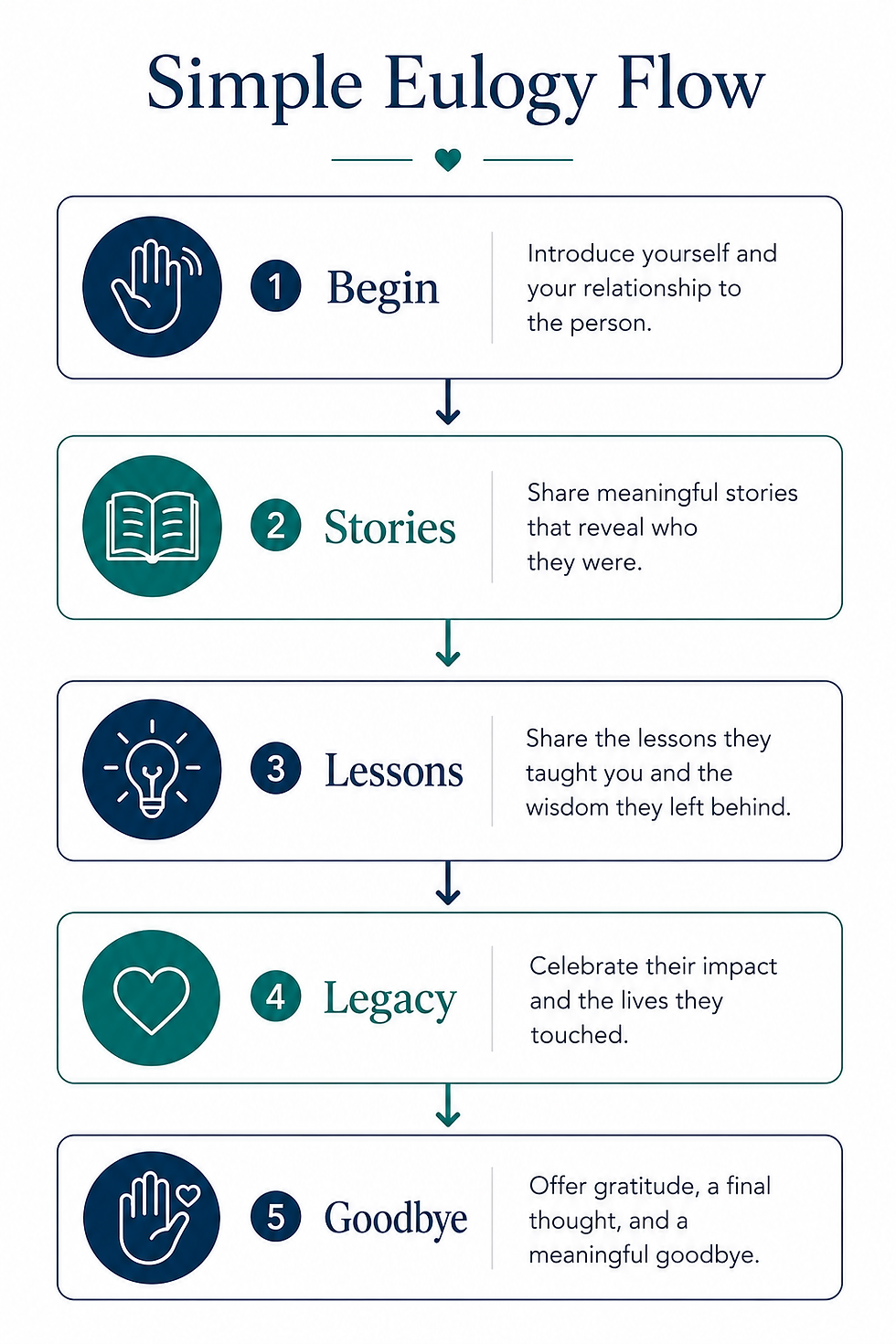
Once you understand this structure, writing becomes much less intimidating.
For a complete walkthrough, examples, and detailed guidance, read our article: How to Write a Eulogy: Step-by-Step Guide with Examples
You may also find these resources helpful:
Short Eulogy Examples That Honor a Loved One Beautifully
How to End a Eulogy: Powerful Closing Examples & Tips
Related Resources
If you're preparing a eulogy and looking for additional guidance, these resources can help you organize your thoughts, uncover meaningful stories, and prepare a heartfelt tribute.
How to Write a Eulogy — Learn how to structure a eulogy, organize memories, and create a meaningful tribute from beginning to end.
How to End a Eulogy — Explore powerful closing examples, meaningful final thoughts, and ways to conclude a eulogy with confidence.
How Long Should a Eulogy Be? — Learn the ideal length for a eulogy, recommended word counts, and practical tips for delivering your remarks.
How to Write an Obituary - Templates & Examples on the best way to write a meaningful obituary.
Frequently Asked Questions
What should I say at the beginning of a eulogy?
Most eulogies begin by thanking attendees, introducing yourself, and sharing a brief reflection or memory about the person being honored. The goal is to create a natural transition into the stories and memories that follow.
Is it okay to start a eulogy with a story?
Absolutely. Many of the most memorable eulogies begin with a meaningful story that captures the personality, character, or impact of the person being remembered.
What if I become emotional while giving a eulogy?
Becoming emotional is completely normal. Pause when needed, take a breath, and continue when you're ready. Most people in attendance understand how difficult it can be to speak about someone you love.
Should I introduce myself before a eulogy?
Yes. Even if many attendees know who you are, there may be people from other parts of your loved one's life who do not. A brief introduction helps create context.
How long should the opening of a eulogy be?
Most openings are between 30 seconds and two minutes. The purpose is simply to welcome listeners, establish your relationship, and begin the tribute naturally.
Final Thoughts
Many people spend days worrying about how to start a eulogy.
They search for examples.
They rewrite opening sentences.
They wonder whether they are saying the right thing.
But the truth is that the best eulogy openings are rarely perfect.
They are personal.
They are sincere.
They sound like the person speaking them.
Whether you begin with a story, a memory, a moment of gratitude, a meaningful quote, or even a touch of humor, what matters most is that your words reflect the person you loved.
Start simple.
Start honestly.
Start with a memory.
The perfect opening is not the goal.
Helping others remember is.
Because once you begin, the stories often find their way to the surface.
And those stories are what people will remember long after the service ends.
At Lastly.com, Last Words Matter™
The final words spoken about a person's life often become part of how they are remembered.
A meaningful eulogy is more than a speech. It is an opportunity to honor a life, preserve memories, and share the stories that mattered most.
Lastly® helps families uncover memories, preserve meaningful details, and craft thoughtful LifeStories® through guided reflection designed for obituaries, eulogies, and lasting tributes.


Comments